Posted on Leave a comment

LinkedIn: You Are One in a Hundred Million

Earlier this week, LinkedIn registered their 100 millionth member. They are currently registering a new member at the rate of one per second. While the number still lags behind Facebook, it is a significant milestone and shows strong growth for the professional networking service.

I first heard about the milestone when I received (along with a million others) the following email from Reid Hoffman, co-founder and chairman of LinkedIn:

Dear Jeff,

I want to personally thank you because you were one of LinkedIn’s first million members (member number 548570 in fact!*). In any technology adoption lifecycle, there are the early adopters, those who help lead the way. That was you.

We hit a big milestone at LinkedIn this week when our 100 millionth member joined the site.

When we founded LinkedIn, our vision was to help the world’s professionals be more successful and productive. Today, with your help, LinkedIn is changing the lives of millions of members by helping them connect with others, find jobs, get insights, start a business, and much more.

We are grateful for your support and look forward to helping you accomplish much more in the years to come. I hope that you are having a great year.

Honestly, I have not been a very active LinkedIn user until recently, and I am still learning the ropes. But if you haven’t checked it out, it’s probably time for a fresh look. That’s why I’ve signed up for Neal Schaffer‘s upcoming LinkedIn Workshop on April 19th at SMMOC Labs.

Neal is an recognized LinkedIn expert and author of Understanding, Leveraging and Maximizing LinkedIn. He held a similar workshop back in the fall and got rave reviews. It’s a hands-on workshop — bring your laptop and be prepared to take specific steps that will help you get more value from LinkedIn. Join me there, and feel free to connect with me on LinkedIn.

So What Does 100 Million Members Look Like?

Here is a great infographic that illustrates what 100,000,000 members looks like.


Posted on 6 Comments

Why Face to Face Still Matters in Social Media

Last month, I shared how face-to-face meetings still matter. You might assume that the realm of social media — which by it’s very definition encourages online community and relationship building — wouldn’t really gain much through real life interaction. You’d be dead wrong.

Social Media in the Real OC

Scott Stratton at LinkedOC

Here in Orange County we are fortunate to have a thriving social media community, supported by a number of regular, live events. Bryan Elliot’s LinkedOC leverages LinkedIn and holds monthly networking events with great speakers such as Scott Stratton and Seth Godin. These are big events, but you meet a number of interesting people who are building their tribe. LinkedOC lies somewhere between a social media group and an old school networking meeting.

My favorite event remains Bob Watson’s Social Media Masterminds of Orange County — or simply SMMOC. This group meets nearly every week on Saturday mornings from 9-11am in Costa Mesa, and draws a wide range of people with an interest in social media — from consultants to mommy bloggers and real estate professionals to enthusiasts.

The whiteboard at SMMOC. Click to enlarge.

The agenda is flexible. There is no projector or monitor, but there is wifi in the room. Attendees are free to use the whiteboard to write down discussion topics or share their Twitter handle. Bob is a terrific facilitator, deftly leading the group through two hours of fantastic interaction and learning. There are just three rules: no self-promotion, no acronyms (at least, not without a definition) and there are no dumb questions.

This group is up on the latest happenings in the social media realm, so whether you’re new to social media or an old pro (what defines someone as an old pro in social media??), you will learn and grow from the discussion. But the real value is in the relationships that are made and bonded through the face-to-face interaction.

SMMOC - Everyone participates

I’ve met and developed connections with a number of local social media mavens, mavericks and masterminds through SMMOC, including Bob (The Man) Watson, Mel Aclaro, Carina Zimmer, Scott Schang, Kirsten Wright, fellow San Clemente local Doug McClure, Matthew Gallizzi, Stacey Harmon, Chris Van Dusen, Eric Stegemann,  Michelle Lecours and too many to list here.

There is also a fair amount of crossover between this group and another of my favorite groups, the OC WordPress Meetup. Steve Zehngut and Jeff Turner of Zeek Interactive are sometimes in attendance, as are regulars Loren Nason, Cindy Ronzoni, Ross Teasley and Joan Ganter.

These people have helped me refine how I use social media, encouraged me to improve my blogging and helped me stay on top of the ever-changing social media landscape. My life is richer for the relationships.

Can you develop community and relationships entirely using social media alone? Certainly, but real-world face time strengthens those connections and accelerates the process.

How are face-to-face interactions helping strengthen your social and professional network?

Posted on 23 Comments

29 Posts in 29 Days

Click for the original Olibac image on Flickr
Photo credit: Olibac

On January 5, 2011,  I committed to writing a post a day for 365 days. After 29 days, I’m happy to report that I’m on track with 29 posts in 29 days. All it took was a little nudge from Scott Berkun and the other good folks at WordPress.

Just about one month into the routine, I’ve made a few observations that might be of use to anyone else considering a similar challenge.

  1. Writing a post a day takes discipline. In hindsight, I realized that I implied a post a day on this blog. That alone is a commitment (I already have a full-time career). And I promised “no fluff” — I want to write posts of the same quality that I like to read. Compounding the commitment are my work commitments and other websites, and you quickly see how a post a day is just the tip of the iceberg.
  2. Planning is essential, as I noted in post #17/365. I’m using the draft status to collect ideas and thoughts on articles I want to write, or to align publication with related events. I collect my thoughts over days and weeks, and this has greatly simplified the process of sitting down to actually write the finished article.
  3. Brainstorming helps, too! I tap into resources from Facebook and Twitter. I gain a lot of ideas from scanning my feeds on Flipboard or reading sites like The Daily Post which share topics and ideas for writing.
  4. Most of all, the support of the community helps keep you going! I have the good fortune to have a great girlfriend who inspires me (check out her blog), and a number of friends in the local WordPress and social media community here in Orange County who keep me challenged. Many thanks go out to Darin McClure, Holly Schwartz, Suki Beasla and Matthew Gallizzi. We all meet at SMMOC several times a month, and all have taking up the call to write one post a day. And we use Twitter every day, encouraging and challenging each other to keep up the cause.

The icing on the cake? I’m having fun! I have a lot to write about — much more than I have time to write. So far there is absolutely zero chance that the well will run dry. That may be either a blessing or a curse depending on your opinion of my stuff, but I’m having a good time, and more than a few people are taking the journey with me.

It’s ironic. I kicked off this year with a photo project called Project 365, where I shoot at least one photo a day for the entire year. I had heard of this before from a friend, but decided to jump in and give it a shot. There has been a synergistic relationship between the two projects. Sometimes my photo of the day will spawn an idea that I simply must write about, and sometimes the article will inspire a creative photo.

How about you? Are you taking on a post- or photo-a-day challenge? Maybe you have in the past? What has your experience been?

Posted on 12 Comments

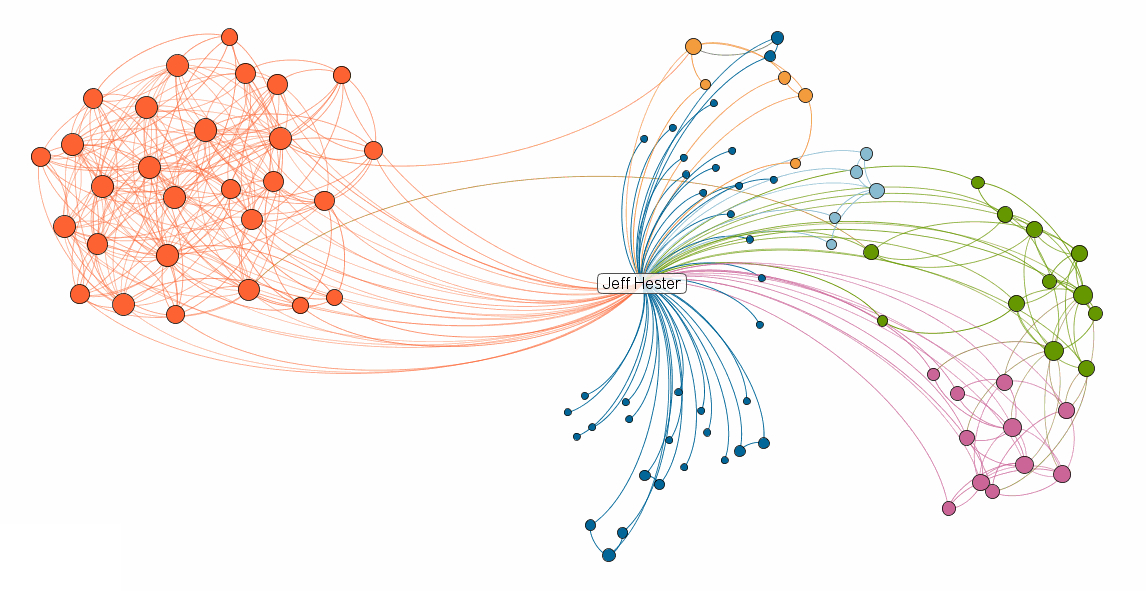
Visualize Your Professional Network with InMaps

LinkedIn Labs has introduced InMaps – a visualization of your LinkedIn network. I first heard about InMaps via a Tweet from fellow #SMMOCer Mel Aclaro. LinkedIn wisely made sharing easy, and so a quick search will find plenty of fresh tweets about this as people discover the new feature.

I gave InMaps a quick spin and quickly discovered LinkedIn’s not-so-subtle ulterior motive: You can’t create a visualization unless you have at least 50 connections and your profile is at least 75% complete.

I’ll bet you a cold beverage that LinkedIn enjoys an sudden surge in both profile completion and network connections as a result.

For LinkedIn, it’s a brilliant move. By offering something sexy that people want (the groovy diagrams) but requiring them to step up and engage on a deeper level, the entire network wins. And (theoretically) they drive the behavior that they want from their community — people sharing deeper knowledge about their experience and connections.

How can we bring change to our community/organization/business/world? One small incentive at a time.

If you care, you can check out my visualization, create your own, or connect with me on LinkedIn.

Posted on 1 Comment

What is Quora, and Why Should I Care?

If you haven’t heard of Quora, you should. It’s been getting a lot of buzz. What is Quora? According to their website, “Quora is a continually improving collection of questions and answers created, edited, and organized by everyone who uses it. Quora was founded in April 2009 by Adam D’Angelo, who was previously CTO and VP of engineering at Facebook, and Charlie Cheever, who led Facebook Connect and Facebook Platform. Quora is privately held and funded by Benchmark Capital, and is based in Palo Alto, CA.”

Having been involved in discussion forums, developing online communities such as BigBlueBall as well as enterprise communities in the context of knowledge management (KM), what’s interesting to me is how Quora takes the traditional threaded discussion format and completely reinvents it, with some excellent results.

Granted, there are important differences between Quora and a discussion forum. Quora is specifically and exclusively suited to a question and answer format. Forums can serve a much broader purpose, including open discussions, brainstorming and ad hoc, asynchronous collaboration. But when you look at most forums, a large percentage of the discussions begin with someone who needs help (they have a question) and subsequent responses (answers, in the best case scenario).

How does Quora do this differently? First of all, forums typically require the participants to begin by navigating to the category that is best suited to their topic. This alone can quickly become a barrier, as the way I would categorize something might be very different than the way other people would. In Quora, you simply ask a question. You have the option of tagging a question with one or more keywords (roughly analogous to categories). Other Quora users can follow (think subscribe) specific questions if they are curious about the answer, or they can follow a tag and get notified of any activity tagged with that keyword.

Second, where forum are typically listed in either a threaded view (i.e. Slashdot) or chronological view, Quora allows the responses to be resorted. Other Quora users can vote on the best answers, and they percolate to the top.

The Q&A type site isn’t really anything new. Google tried it before, and failed. Yahoo! Answers is another service that has hung in there, but the quality is spotty. So far, the quality of the responses has really set Quora apart. It’s not uncommon to see a CEO or founder of a company jump in with a response to a question about their business model. The particpants, by and large, are a higher caliber than I’ve seen in similar systems.

What happens next? Last week at the Social Media MasterMinds meetup in Orange County, we speculated that the opportunity for Quora has already come and gone. The theory is that once it goes mainstream, the quality suffers. The noise level increases as people look for ways to “use” Quora to improve their SEO, market their company or service, or insert spam links for pharmaceuticals.

I’m still in discovery mode on Quora. I’m following a few topics — some personal (hiking) and some professional (knowledge management). I’ve voted up a few good answers, added an answer, and asked a couple questions (with mixed results so far). The process has been interesting and even useful, but the jury is still out on whether I’ll stick with it. For now, you can me find here on Quora.

If you work with forums, online communities or KM, Quora is worth looking at. Consider it food for thought.