Posted on 2 Comments

Time Management, Jawbreakers and M&Ms

Time Management & Candy

Recently, the staff where my wife works attended two days of training on the Seven Habits of Highly Effective People. One of the exercises she was given used an analogy of rocks and sand to represent time management.

Ah hah! I gave a presentation to that effect at a KM Summit back in 2006. I can fill in with some visuals, but instead of rocks and sand, I’ll use jawbreakers and M&Ms.

Time is Democratic

Rich or poor, young or old, we all have precisely 24 hours in a day, and seven days in our week. It’s what we do with those hours that distinguishes us.

To illustrate, consider the jawbreaker as that big, important task that Must Be Done. It’s probably not easy. You may not even particularly relish the idea of hunkering down and getting it done. But it’s there, along with a number of other Big Important Tasks.

Which goes first?

The M&Ms are the small, urgent tasks. Sometimes they’re the little fires that break out during the day as you rush from stomping out the last one. They can be provide quick gratification as you tick off items in your to-do list, but they ultimately they are not as important as the jawbreakers.

Urgent? Perhaps. Do they help move you closer to your big goals? Not so much.

The mistake many of us make is that we start our day by succumbing to the tyranny of the urgent. The M&Ms. Why is that a problem? Try this exercise. It begins with a bowl-full of jawbreakers and a couple pounds of M&Ms.

Putting the little tasks first...

If we take the M&Ms and pour it into our empty vase, and add the jawbreakers afterwards, you’ll find they won’t all fit. Our day planner runneth over.

Wrong priorities

Putting the Big Important Tasks First

Next, try putting all the jawbreakers–the Big Important Tasks–first. They all fit in the vase.

Put the big tasks first...

Finally, pour in the M&Ms and magically–they also fit–easily filling the empty spaces between the jawbreakers.

It all fits, when you do it right.

What are those urgent little tasks that are filling up your day? What are the Big Important Tasks that you never seem to have enough time to finish?

Brainstorm a few and inverting the priorities and you’ll make great strides toward reaching those big goals. 

Posted on Leave a comment

2013 Enterprise Collaboration Survey

collaborationCollaboration. Do it well, and it can improve the quality and velocity of results. Many of us collaborate on a routine basis, and have done so for years.

When I first began working, collaboration largely involved face-to-face interaction. Asking a colleague a question; getting feedback; informing decisions. Today, networks have transformed collaboration, enabling us to share our expertise and make virtual connections across the world.

I am researching how enterprises are collaborating in 2013, both inside and outside the firewall, and I need your help.

If you work for a company, organization or institution and routinely collaborate either internally or externally, take 5-10 minutes to answer this short, eleven question survey.

I will aggregating, anonymizing and share the results.

Take the 2013 Enterprise Collaboration Survey now, and share with your network. 

Posted on 5 Comments

The What and Why of WordCamp

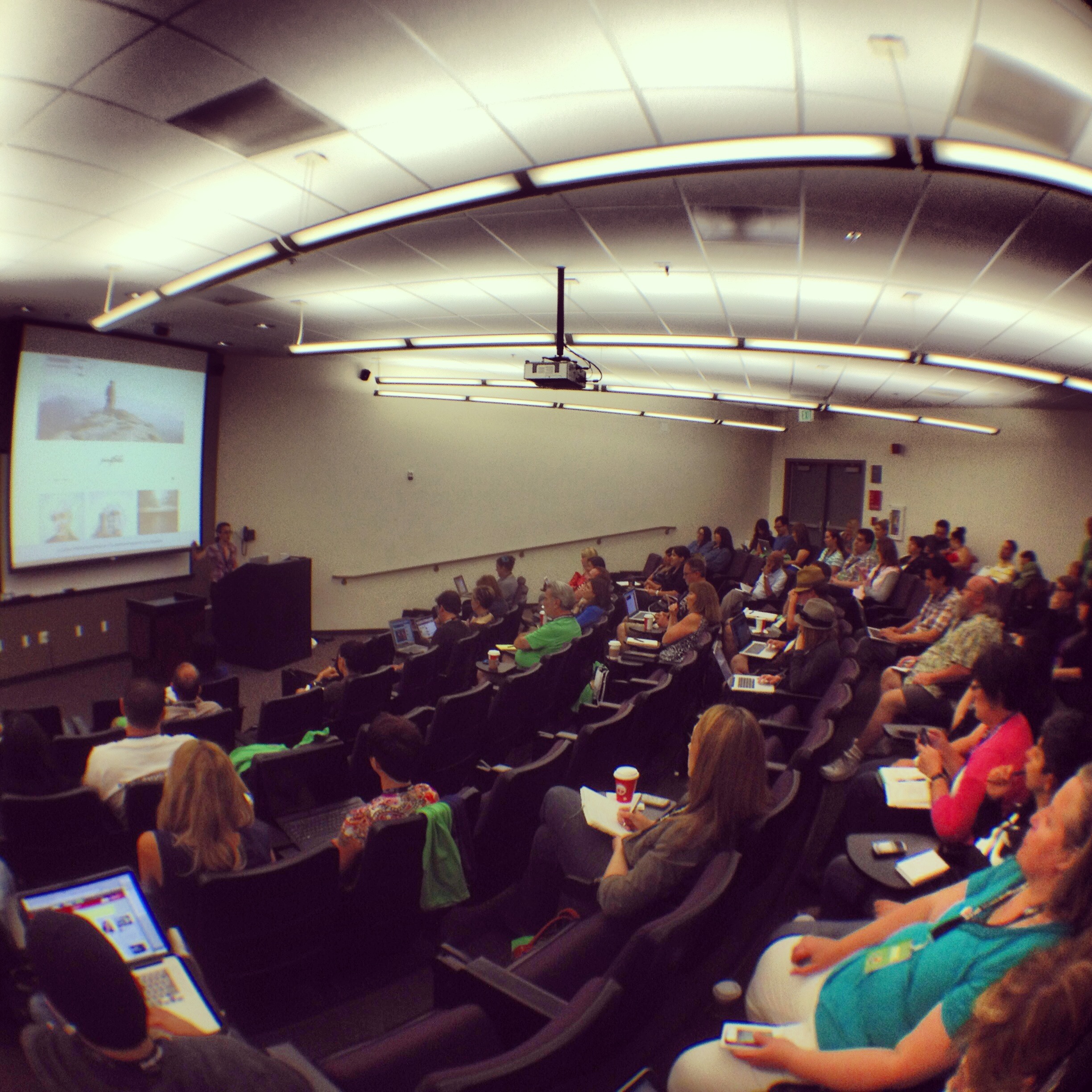
Saturday I spent the day with a couple hundred web developers, designers, publishers and blogging enthusiasts at an event called WordCamp OC. This the fourth annual WordCamp Orange County, and the eleventh WordCamp I’ve participated in.

WordPress OC

What is WordCamp?

I shared my plans for WordCamp with one of my hiking friends, Paul. He reasoned, “Oh, that’s why you’re so good at Words With Friends!” No, WordCamp isn’t about word play or word games. WordCamp is about WordPress — the open source content management system that powers about 22% of all new web sites on the Internet. As far as conferences go, these are local events organized by volunteers with the support of the WordPress community at large. Often people travel across state lines or even the country to attend. The speakers are practitioners who use WordPress, build sites using WordPress, and speak from practical experience. And unlike most professional conferences where registration often can cost hundreds or thousands of dollars, WordCamp OC was a mere $35, including two days of sessions, a t-shirt, coffee, lunch, snacks and beverages. That alone is worth much more, but the real value doesn’t show up on the conference schedule.

Why WordCamp?

wcoc2013_badge_im_heading_toThe challenge with WordCamp is serving the market. There’s a wide range of people interested in WordPress. Many are web developers, often specializing in building complex web applications using WordPress as a framework. Others are designers, trying to figure out how to create head-turning designs on a well-supported platform with a huge market. And still others own small businesses, or are aspiring entrepreneurs or bloggers looking to establish or just improve their own web presence.

I’ve been designing and developing web sites since 1995. I started building static web sites — as was the norm — but quickly moved to developing dynamic, database-driven sites. Such sites are easier to maintain and update, and quickly became the norm for most commercial sites. The challenge back in the 90’s was that the backend platform was the responsibility of the developer. Complex sites typically included a custom content management system on the backend. For me, that was built using Microsoft technologies: IIS, MS SQL Server databases and Active Server Pages (ASP).

In 2001, I began experimenting with emerging blogging platforms. At the time, Movable Type was at the forefront. I started this blog on it, and it served me well. in 2005, I made a decision to switch my development focus entirely from developing on ASP to PHP. Several of my sites were converted as well — a major task.

And in 2007, I began looking at PHP-based content management systems (CMS). I had done some development using Drupal, and was testing Joomla. But in August 2007, I made a trip to San Francisco for my first-ever WordCamp. What I saw and learned over that weekend convinced me that WordPress would become my development platform of choice. And I haven’t looked back.

The WordPress community is rich with resources — millions of smart people who willingly share their knowledge and own experience. And the WordCamp events around the world give them an opportunity to gather face-to-face for real interaction.  This interaction happens all the time, in online communities, forums, in Facebook groups, on Twitter, via podcasts and through local WordPress Meetup groups. But the annual WordCamp has become a bit like the grown-up version of summer camp. It’s a chance to reconnect with your friends and colleagues. There are equal doses of learning, sharing, fun and frivolity. It strengthens the bonds of the community. WordCamp keeps the community vibrant, dynamic and growing.

I love that we live in an age where virtual communication and collaboration is so easy to achieve. But it will never replace the value of sitting around the table sharing a taco with colleagues and talking about our world travels. And sometimes we talk about WordPress, too.

What do you find most valuable about the conferences you attend?

Leave a comment and let me know where you find value in face to face conferences.

And thanks to Brandon Dove, Jeffrey Zinn, the fantastic speakers, volunteers and attendees who all make WordCamp an event worth participating in.


Posted on 3 Comments

Customer Service, Social Networks and Fixing What’s Broken

Break Free

It’s easy to pick on the cable company. Most of them are easy targets for derision. The services are overpriced and the customer service often ends up the butt of jokes.

I’ve had my own ups-and-downs with my current cable company — Time Warner Cable. Most recently, this centered around a single episode of a single show: Homeland, Season 2, Episode 11.

The Backstory

I have been catching up on the Homeland Season 2 replay on Showtime, recording episodes using a Season Pass on TiVo. For whatever reason, episode eleven eluded the long arms of my HDR while we were away in Sonoma. My challenge? How to legally get the missing episode.

The first option would normally be to use the on demand functionality provided through TWC. Unfortunately, because I use a TiVo box with a cable card, the on demand functionality is not available.

HBO has a great app for the iPad that lets you view pretty much any episode of any of their series, going back for years. You can even view it via AirPlay and your Apple TV. Too bad Homeland is on Showtime. Fortunately, Showtime also has an iPad app with similar on demand playback. Unfortunately it only works with certain cable providers — and TWC is not one of them.

Fortunately, TWC has it’s own iPad app called TWC TV which provides on demand functionality, including Showtime series (if you’re a subscriber, which I am). This was promising. I searched for Homeland, found Season 2, clicked on Episode 11, and… FAIL! It would not play. Check episode 10. That works. Episode 12? That also works. Episode 11 is the only episode that won’t play.

Calling TWC customer service led to the typical, unfulfilling canned responses. “Are you able to play other episodes?” Yes. “Have you tried the on-demand feature on your TV” No, I cannot because I use a cable card and a TiVo, not a cable box. “Have you tried reinstalling the TWC TV app?” Yes, with the same results. Finally they were able to confirm with another tech who had an iPad that they, too, could not play Homeland, Season 2, Episode 11. The answer? They would have to re-load the episode on their on-demand server, and to keep trying in a few days. I would not get any notification when (or if) it were resolved.

Two weeks later. Episode 11 will not play. In fact, it’s disappeared from the episode list entirely.

homeland-error

This time, a tweet was in order.

Next, TWC is calling me, to help sort out the problem Again, we repeat the dance. “Are you able to play other episodes?” Finally, I get them to realize (again) that the problem is with that particular episode on their server. And again, the solution? Wait a few days and try again.

Frustrated, I finally decide to bring the cable box out of the closet, dust it off and hook it up. Had to dig out a couple coaxial cables and a splitter, and add to the tangle of cables. Finally, it’s all hooked up. Fire up the cable box, press the “on demand” button and… FAIL. Ugh.

One more phone call to TWC support, and they send a signal to the box. Finally it’s working  (though still not on the TWC TV app).

The Lesson Learned

There’s a few lessons in this experience. First, it was interesting to note that TWC is actively monitoring Twitter. It’s a smart move for them, even though they weren’t able to actually solve the problem.

 …Remember, these days, when you’re talking to one person, you’re talking to a thousand. -Zoe Barnes, House of Cards

From a consumer perspective, I got more intelligent response from a tweet than from a phone call to their toll-free customer service line. Of course I made a point of mentioning the TWC twitter account, but it got action–and more intelligent action–much faster. Social networks empower consumers.

Which leads to the more important lesson. Having responsive customer service is only meaningful if you can actually fix the problem. In this case, TWC failed. Granted, it may be fixed eventually, but they weren’t equipped to resolve the issue even after several weeks. It’s a problem of bureaucracy, and a symptom of broken processes in the organization. The real problem for TWC in this case is not one of sloppy customer service, but an inability to fix what’s broken with their own internal processes.

A Broader Application

All of this begs the question: What’s broken in your company? In your organization? In your life or relationships? If the experience sucks, something must change. Fixing the problem involves change. Embrace the change. 

Insanity: doing the same thing over and over again and expecting different results. – Albert Einstein

Postscript

For what it’s worth, I was finally able to watch Homeland, Season 2, Episode 11 last night. And yes, it was worth it.

Photo credit: Nickwheeleroz on Flickr

Posted on Leave a comment

PechaKucha Night Fullerton

pechakucha

Have you been to a PechaKucha Night? These lively events feature short, six-minute presentations with precisely 20 slides — each slide displayed for 20 seconds–20×20. It’s been adapted by other groups such as Ignite (who uses a 20×15 format). One of the wonderful things about these events are the energy and fun. The 20×20 cadence requires presenters to be concise and really get to the salient points. And conversely, if a speaker sucks, the suffering only lasts for six minutes.

I’ll be presenting tonight at the first quarterly PechaKucha Night Fullerton. Interested in joining a group of smart, artistic, creative and thoughtful folks? Get all the details.

Posted on Leave a comment

The New Linkedin Profile: Love It or Hate It?

Back in October 2012, LinkedIn announced a redesigned profile page. They’ve been slowly rolling it out to users, and finally updated mine this week.

What’s new in the new profile design?

For starters, the interface has been refreshed, with sections clearly noted. And it features inline editing, meaning you can make changes right from your profile without switching to a separate “edit” view. See something that needs updating? You can change it right there.

Your recent activity is highlighted near the top of your profile. While this is useful to see if someone is actively interacting on LinkedIn, it will make me think twice before posting a link or liking an update.

There is a new visual representation of your network–a sort of simplified InMaps view–and you as you hover over other LinkedIn members, you’ll see a card pop-up with additional info about that person. Their goal is to stimulate interaction and engagement with your network.

What’s no longer there? 

There are some features, particularly third-party apps, that don’t show up anymore. I only used a couple of these; the TripIt widget and the Reading List. Not really critical.

Overall, I like the new design. It’s not going to rock your world, but it’s a nice update to an otherwise stodgy user interface. But what do you think? Let me know in the comments, and feel free to connect with me on LinkedIn.

jeff-hester-on-linkedin

Posted on 1 Comment

Election Day, the Wisdom of Crowds, and the Enterprise

In The Wisdom of Crowds, author James Surowiecki suggests that leveraging the collective can often yield better results that asking any single expert. On election day, there are plenty of examples of crowd wisdom and prediction markets to draw from.

In business, we’re often focused on efficiency innovations — incremental improvements in efficiency that save time, money, or preferably both. So can crowdsourcing be used to automated processes effectively in the enterprise?

The answer? It depends on the question. 

If the problem can be represented by a simply solution such as single number (42?), or deals primarily with optimization, then crowdsourcing can make a lot of sense. In the presidential election, leveraging the crowd to predict the winner fits the first dimension perfectly. There can be only one winner: either Romney or Obama.

If the problem, on the other hand, is complex, requiring wisdom and expertise, the crowd will be of little help. If you need to engineer a fuel system for a new airplane, the crowd may actually do more harm than good. While “asking the audience” may work statistically for “Who Wants to Be a Millionaire,” remember that those questions also present multiple choice answers. And do you want to be on the maiden voyage of a new aircraft designed by the crowd?

Part of the problem–and therefore, the solution–comes from defining what we mean by crowdsourcing. Is it asking for an answer, even from the uninformed? If we’re talking elections, yes. If we’re talking jet propulsion, absolutely not.

Can we apply the wisdom of crowds in the enterprise? Certainly, but we must do so thoughtfully. Polling the crowd, whether that be inside our outside the firewall, can help inform decision-making. The crowd can either confirm or challenge our conclusions, but it does not replace the need for critical thought. And when safety is on the line, we have to be vigilant that we don’t allow a confirmation by the crowd to lull us into happily accepting our hopeful answer as the correct one.

After all, the crowd can be wrong. 

What do you think? How and when would you apply the wisdom of crowds inside your organization?