Posted on 3 Comments

Customer Service, Social Networks and Fixing What’s Broken

Break Free

It’s easy to pick on the cable company. Most of them are easy targets for derision. The services are overpriced and the customer service often ends up the butt of jokes.

I’ve had my own ups-and-downs with my current cable company — Time Warner Cable. Most recently, this centered around a single episode of a single show: Homeland, Season 2, Episode 11.

The Backstory

I have been catching up on the Homeland Season 2 replay on Showtime, recording episodes using a Season Pass on TiVo. For whatever reason, episode eleven eluded the long arms of my HDR while we were away in Sonoma. My challenge? How to legally get the missing episode.

The first option would normally be to use the on demand functionality provided through TWC. Unfortunately, because I use a TiVo box with a cable card, the on demand functionality is not available.

HBO has a great app for the iPad that lets you view pretty much any episode of any of their series, going back for years. You can even view it via AirPlay and your Apple TV. Too bad Homeland is on Showtime. Fortunately, Showtime also has an iPad app with similar on demand playback. Unfortunately it only works with certain cable providers — and TWC is not one of them.

Fortunately, TWC has it’s own iPad app called TWC TV which provides on demand functionality, including Showtime series (if you’re a subscriber, which I am). This was promising. I searched for Homeland, found Season 2, clicked on Episode 11, and… FAIL! It would not play. Check episode 10. That works. Episode 12? That also works. Episode 11 is the only episode that won’t play.

Calling TWC customer service led to the typical, unfulfilling canned responses. “Are you able to play other episodes?” Yes. “Have you tried the on-demand feature on your TV” No, I cannot because I use a cable card and a TiVo, not a cable box. “Have you tried reinstalling the TWC TV app?” Yes, with the same results. Finally they were able to confirm with another tech who had an iPad that they, too, could not play Homeland, Season 2, Episode 11. The answer? They would have to re-load the episode on their on-demand server, and to keep trying in a few days. I would not get any notification when (or if) it were resolved.

Two weeks later. Episode 11 will not play. In fact, it’s disappeared from the episode list entirely.

homeland-error

This time, a tweet was in order.

Next, TWC is calling me, to help sort out the problem Again, we repeat the dance. “Are you able to play other episodes?” Finally, I get them to realize (again) that the problem is with that particular episode on their server. And again, the solution? Wait a few days and try again.

Frustrated, I finally decide to bring the cable box out of the closet, dust it off and hook it up. Had to dig out a couple coaxial cables and a splitter, and add to the tangle of cables. Finally, it’s all hooked up. Fire up the cable box, press the “on demand” button and… FAIL. Ugh.

One more phone call to TWC support, and they send a signal to the box. Finally it’s working  (though still not on the TWC TV app).

The Lesson Learned

There’s a few lessons in this experience. First, it was interesting to note that TWC is actively monitoring Twitter. It’s a smart move for them, even though they weren’t able to actually solve the problem.

 …Remember, these days, when you’re talking to one person, you’re talking to a thousand. -Zoe Barnes, House of Cards

From a consumer perspective, I got more intelligent response from a tweet than from a phone call to their toll-free customer service line. Of course I made a point of mentioning the TWC twitter account, but it got action–and more intelligent action–much faster. Social networks empower consumers.

Which leads to the more important lesson. Having responsive customer service is only meaningful if you can actually fix the problem. In this case, TWC failed. Granted, it may be fixed eventually, but they weren’t equipped to resolve the issue even after several weeks. It’s a problem of bureaucracy, and a symptom of broken processes in the organization. The real problem for TWC in this case is not one of sloppy customer service, but an inability to fix what’s broken with their own internal processes.

A Broader Application

All of this begs the question: What’s broken in your company? In your organization? In your life or relationships? If the experience sucks, something must change. Fixing the problem involves change. Embrace the change. 

Insanity: doing the same thing over and over again and expecting different results. – Albert Einstein

Postscript

For what it’s worth, I was finally able to watch Homeland, Season 2, Episode 11 last night. And yes, it was worth it.

Photo credit: Nickwheeleroz on Flickr

Posted on 1 Comment

Face-to-Face Still Matters

Earlier today we wrapped up three consecutive days of video teleconferences to train five new knowledge managers. The trainees were located in Greenville, Calgary and Houston, while the other trainers and I were primarly located in Southern California. In better economic times, our trainees would have travelled to Southern California for the week,  spending some serious face time not only with those of us leading the training, but with most of the core KM team.
This face-to-face KM immersion did two things:

First, it allowed them to focus on what they where learning, without the distractions of the everyday office activities around them. Sitting and working side-by-side with the KM team gave them an opportunity to really absorb a great deal of knowledge that wasn’t necessarily a part of the training outline.

But the second, and even more important result was the relationships that were built. In most cases, this gathering was the first time we worked together. In addition to spending most of the work week together, we would eat lunch together and even go out afterwards for dinner or go sailing. The bond that formed provided a solid foundation for an ongoing working relationship. They felt comfortable coming to us because they knew us well. They trusted us, and knew we were there to help them. They understood the gravity of their new role as knowledge managers. They reached out for help or to brainstorm solutions for integrating knowledge management into their community’s work processes, and gladly participated when we asked them to help us with an enterprise KM initiative.

Doing this via video teleconference has required a change in approach. Sessions are shorter, with more pre-reading and pre-work. There are exercises that require multiple touch points with the KM team, ensuring that they will talk with someone on the team on a fairly regular basis. Will this suffice? Not a chance.

Fellow KM-er David Gurteen recently shared a great article on Harvard Business Review via this tweet:

[blackbirdpie url=”https://twitter.com/#!/davidgurteen/status/38593360214106112″]

In his article Why Face-to-Face Meetings Make All the Difference, Stephen Greer describes how use used face-to-face meetings to build and strengthen relationships with his leadership team. Greer concedes that after the relationships had been established, he was able to reduce the frequency of meetings, and conduct more of them remotely.

“Over time, once personalities gelled and relationships bonded, we were able to scale back the frequent flyer miles by making it a quarterly face-to-face meeting, with monthly conference calls in between. Today a videoconference would be the preferable alternative, as technology is definitely bringing distant operations closer together.”

Note that he didn’t jump straight away to conference calls. He notes that it took time to build and bond relationships with face-to-face meetings. Only after those relationships were bonded could they scale back the frequency and begin leveraging alternative technology like video teleconferencing.

Yes, face-to-face still matters.

The challenge is this: What do you do when face-to-face is not an option? How do you build those relationships that are necessary to create trust between people who don’t really know each other that well?

Posted on Leave a comment

Seth Godin Returns to Orange County

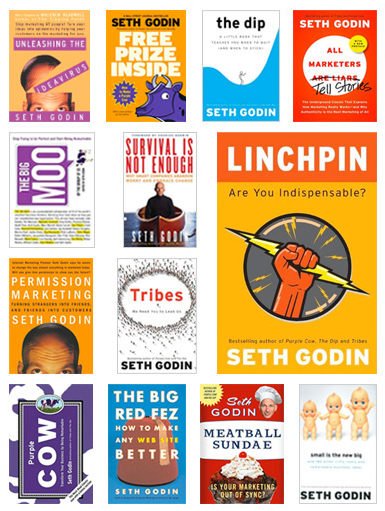
Seth Godin is coming to Orange County! Godin’s twelve books — all of them bestsellers — deal with the post-industrial revolution, the way ideas spread, marketing, quitting, leadership and most of all, changing everything. His blog is considered the most popular marketing blog in the world. And he’s coming to Orange County and you can hear him speak.

On March 2, Seth will be speaking at Renée and Henry Segerstrom Concert Hall. The event — organized by Bryan Elliot as part of Linked Orange County — is a great opportunity to hear from the innovative thought leader who usually is only seen at exclusive events like TED. Tickets are available now, and this is likely to sell out.

I’ve read several of his books, including The Big Moo, Small is the New Big, and Linchpin. He has a way of cutting through the crap and addressing your customer (be they internal or external) in a whole new way. Check out all of Seth Godin’s books (affiliate link).

What’s your take on Seth Godin? Let me know if you going on March 2, and I’ll make a point to say hello.

Posted on 12 Comments

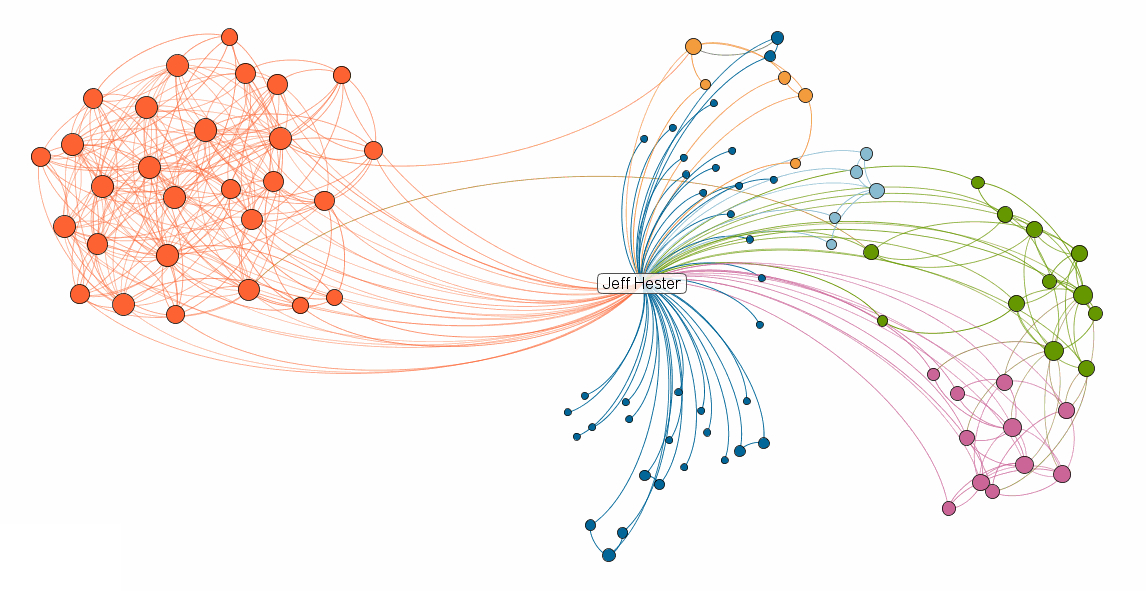
Visualize Your Professional Network with InMaps

LinkedIn Labs has introduced InMaps – a visualization of your LinkedIn network. I first heard about InMaps via a Tweet from fellow #SMMOCer Mel Aclaro. LinkedIn wisely made sharing easy, and so a quick search will find plenty of fresh tweets about this as people discover the new feature.

I gave InMaps a quick spin and quickly discovered LinkedIn’s not-so-subtle ulterior motive: You can’t create a visualization unless you have at least 50 connections and your profile is at least 75% complete.

I’ll bet you a cold beverage that LinkedIn enjoys an sudden surge in both profile completion and network connections as a result.

For LinkedIn, it’s a brilliant move. By offering something sexy that people want (the groovy diagrams) but requiring them to step up and engage on a deeper level, the entire network wins. And (theoretically) they drive the behavior that they want from their community — people sharing deeper knowledge about their experience and connections.

How can we bring change to our community/organization/business/world? One small incentive at a time.

If you care, you can check out my visualization, create your own, or connect with me on LinkedIn.

Posted on 2 Comments

If I Were The Boss…

Knowledge management (KM) can help transform an organization as people begin to connect, leveraging the best knowledge and expertise to improve work processes and deliverables. Last week, I discussed what KM means on a personal level. In many ways, KM thinking is a mindset. The KM mind questions the value of everything, and challenges us to upend the status quo and discover innovative solutions.

One of the ways I sharpen my own KM mindset is through discussion and collaboration with other KM professionals and evangelists. Early today in one of those groups — KMers.org — we discussed how we would run things (from a KM mindset) “if I were the boss.”

Rob Swanwick moderated this tweet chat, seeding the conversation with three questions on “how we would run things (from a KM mindset)”:

  1. If I ran conferences…
  2. If I ran all meetings…
  3. If I controlled the direction for social media in my organization…

This led to a lively discussion with Rob Swanwick, Kate Bowers, Stan Garfield, Barbara Fillip, Liz Williams and others. While there were some excellent, practical tips for running conferences, meetings and managing social media, there was one key concept that particularly stuck out above all else:

THE REAL VALUE LIES IN RELATIONSHIPS

I used to get excited about what I would learn at a conference. It’s taken a few years, but now I understand that the real value isn’t in the content of any particular presentation or discussion, but in the relationships forged and strengthened. Recent research at IBM and MIT confirms this, even going so far as to put a dollar value on those connections. In their estimation, each contact is worth $948 in revenue.

Putting aside the absurdity of assigning a dollar value to a relationship, I suggest that the real value is much, much higher. And we understand this, intrinsically. During our tweet chat, I posed the following question to illustrate this point:

Which has more potential value? The chat transcript of any of these sessions, or the relationships built & strengthened?

While this in no way diminishes the value of the chat, discussion or presentation itself, it does drive home the point that what really matters is the connections. In knowing you, I am a better person. And vice versa. Together we are smarter, more productive, more interesting, more capable than we could ever be on our own. Our diverse perspectives and experience blend to create a wonderful collaborative stew.

If you’re interested in more, you can read the full tweet chat transcript, and continue the dialogue. If you are a KMer, please join is each Tuesday at noon Eastern time for our weekly tweet chat, hosted at KMers.org, and share your thoughts on the future of KM.