Posted on 1 Comment

Adventures in Abu Dhabi: Ferrari World

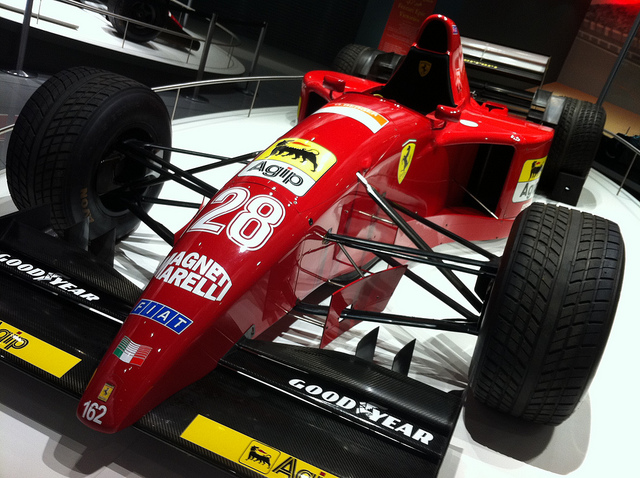
Where else but in the UAE would you find the largest indoor amusement park — devoted to Ferrari — and the world’s fastest roller coaster? Nowhere else.

Saturday was my adjustment day in Abu Dhabi, having travelled eleven time zones from LA, arriving late Friday night. My colleague Tom and I ventured out to visit Ferrari World on the outskirts of town.  We looked forward to staking claim to riding the world’s fastest roller coaster – the Formula Rossa, which hits speeds of 240km/h.

Ferrari World is impressive in size and ambition, but the lack of crowds made us wonder how long it would remain open. For starters, three of the most popular attractions were closed for maintenance — including the world’s fastest roller coaster. Bummer.

We ambled over to the one roller coaster that was open, and were the first two in line. In fact, we were the only two in line. We had to ask to double-check that it was even open (it was). We navigated the serpentine (but empty) queue designed to handle mobs of people and made our way to the ride. We were the only ones on the first trip around the track. When we returned, there was still no line, so we went back. From there on, we didn’t even get off, we just asked them to keep sending us around. We rode it four consecutive times before finally a few people started to filter in.

The crowds did grow a bit over the afternoon, but it was never crowded. And we were both a little disappointed that three of the key attractions were closed (not a good sign).

On the bright side, I did learn a lot about Ferrari and saw some beautiful cars – some historic and many new models. But the experience left me scratching my head and wondering about the business viability of the park.

And while I can’t claim to have ridden the world’s fastest roller coaster, I may be able to say… “I visited Ferrari World back when it was still open.”

All this got me thinking; putting aside questions about whether it’s the right thing to do or not, let’s assume that the objective is to make changes that would help Ferrari World thrive. What changes would help them grow?

One obvious omission was the lack of a Ferrari dealership. Let qualified buyers test drive a Ferrari on the adjacent Formula 1 track (the Yaz Marina Circuit). Let people pickup a new car brochure and dream a bit. Even though the car’s price puts it out of range for most people, I was shocked that this wasn’t there. The “world” was a bit incomplete. You couldn’t even find out how much they cost (at least, it wasn’t apparent).

How would you crank up the buzz and stimulate business?


Posted on 1 Comment

Things Real People Don’t Say About Advertising

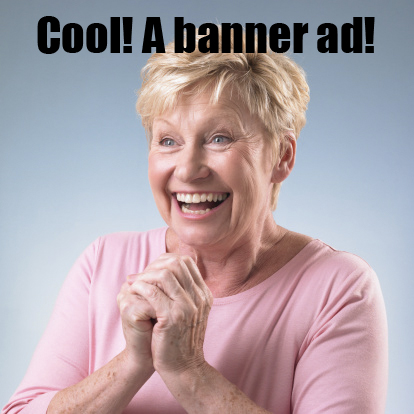
Things Real People Don’t Say About Advertising is a Tumblr-powered collection of cheesy stock photos poking fun at the world of advertising… and advertisers too-often disconnection with reality. It’s a breezy, easy site to scan, in much the same way as the Lolcats at I Can Has Cheezburger.

While it’s sure to make you smile, especially if you’ve been involved in advertising or even commercial web projects, TPDSAA has a very real point. Too often we miss the mark when trying to communicate. We spend too much time on minutiae, and make too many assumptions that “we” know what our audience wants because we think they are just like us.

We Are Not Our Audience

Whether “we” means an ad agency, design firm or an individual simply trying to stake their claim on the Internet, “we” are not the same as everyone else. In fact, everyone else is very different from us. We are too close to the subject to see it through the eyes of the average visitor.

Over and over I’ve heard anecdotes of people recruiting their mom as the ultimate usability tester. The assumption is, if mom gets it, everyone will. Honestly, this is not far from the truth. We need to interact. We need to be genuine. We need to ask — our visitors, employees, members or customers — what they really need and want. And then, we need to give it to them.

I’m not suggesting design by committee, or worse, design by community. There is still a need for vision and creativity. Our experience and knowledge can help create a user experience that delights. Doing so requires a combination of that know-how and a willingness to listen and adapt to genuinely serve the audience.

Check out TPDSAA. I guarantee you will find at least a few photos you’ll relate to. And if you’re in a position to influence user experience, think about how you can avoid ending up lampooned on TPDSAA.

Looking to improve user experience? Here’s two companies I recommend:

  • Adaptive Path provides a range of consulting services to help companies improve their user experience, as well as coordinating a series of events and conferences for user experience professionals.
  • Creative Good also provides consulting services for companies who want to improve the user experience, supplemented by councils — groups of peers sharing their knowledge and expertise. The annual GEL conference (Good Experience Live) draws a range of creatives in a format closer to TED than an typical conference.

Meantime, I’m thinking about how I can apply the humor of TPDSAA to the realm of knowledge management. Stay tuned…

Posted on Leave a comment

Seth Godin Returns to Orange County

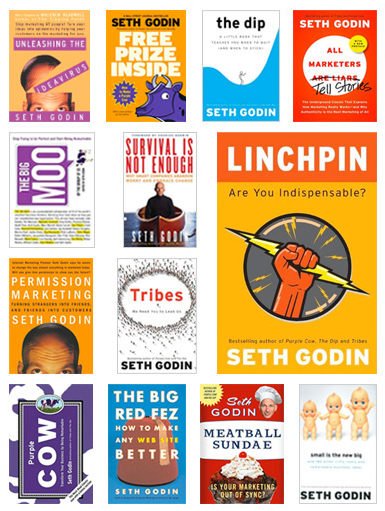
Seth Godin is coming to Orange County! Godin’s twelve books — all of them bestsellers — deal with the post-industrial revolution, the way ideas spread, marketing, quitting, leadership and most of all, changing everything. His blog is considered the most popular marketing blog in the world. And he’s coming to Orange County and you can hear him speak.

On March 2, Seth will be speaking at Renée and Henry Segerstrom Concert Hall. The event — organized by Bryan Elliot as part of Linked Orange County — is a great opportunity to hear from the innovative thought leader who usually is only seen at exclusive events like TED. Tickets are available now, and this is likely to sell out.

I’ve read several of his books, including The Big Moo, Small is the New Big, and Linchpin. He has a way of cutting through the crap and addressing your customer (be they internal or external) in a whole new way. Check out all of Seth Godin’s books (affiliate link).

What’s your take on Seth Godin? Let me know if you going on March 2, and I’ll make a point to say hello.

Posted on Leave a comment

GOTV: Text messages vs. Robo-calls

A couple years ago I helped build this site for researchers at Yale studying the effectiveness of various “get out the vote” efforts. Scott Beauchamp (a colleague from my Winfire days) dropped me a note yesterday saying the site was linked in a couple of places from a great article on Slate discussing the contrasting responses from McCain’s well-known robo-calls and Obama’s extensive use of text messages. 

On the surface, robo-calls and text messages may seem like equal nuisances, but anectdotal evidence suggests that Obama’s text messages have been much more effective. 

With a little thought and it’s easy to understand why. A text message is permission based and less intrusive. I had to provide my mobile number willingly to sign-up for Obama’s text alerts. And I can read them when it’s convenient. In contrast, I have never received a recorded message that didn’t piss me off just a little. Who wants to be interupted by a recorded message? Not me. 

Hats off to Obama for his great use of this technology. And be sure to vote on November 4th.