Posted on 21 Comments

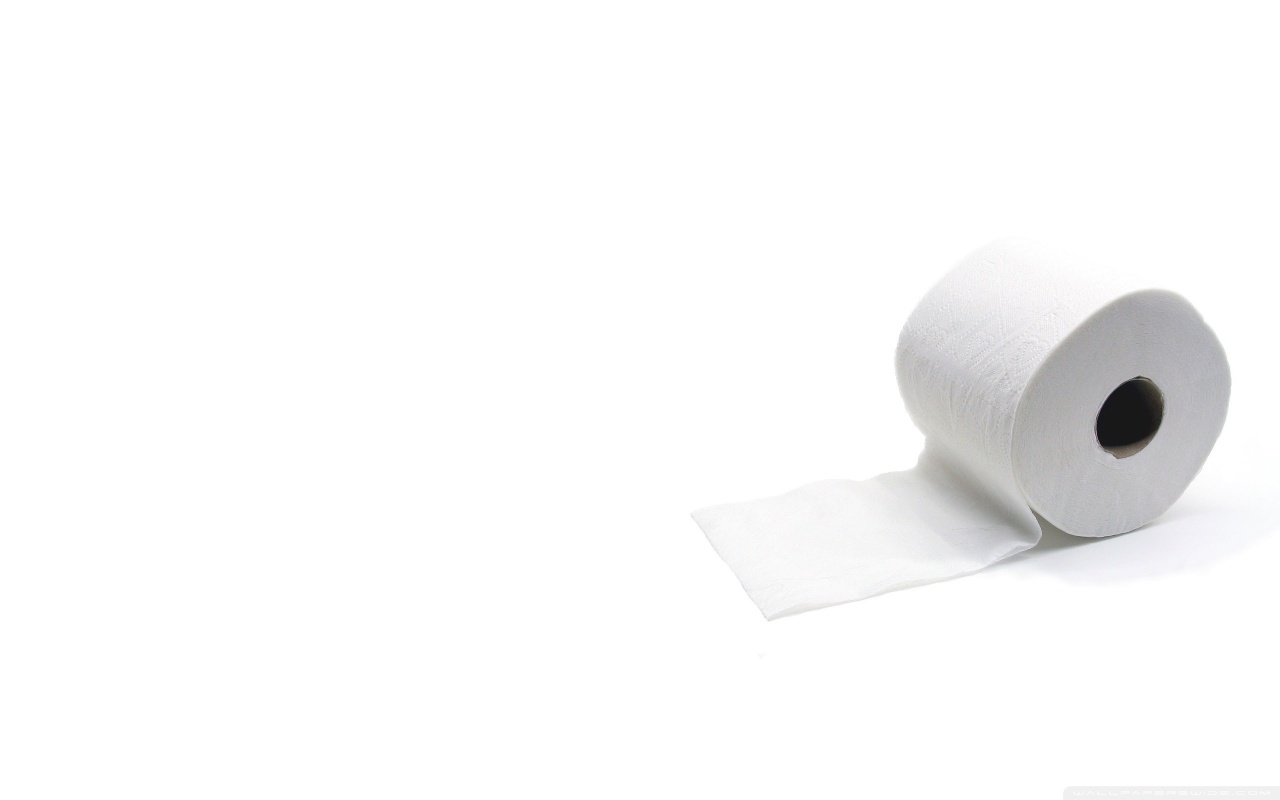
The Correct Way to Hang the Toilet Paper

Having recently moved into a new house, expanding the size (and improving the quality) of the household by 100%, this is but one of the many essential decisions that we made. Yes, it’s the quintessential question — what is the correct way to hang a roll of toilet paper. 

Infographic source: CurrentConfig, who also has a PDF version suitable for printing, folding and hanging on a toilet roll (should you know of someone who needs illumination on the proper technique).
Posted on Leave a comment

April Fools

I’ve landed in Abu Dhabi, checked in and (for the moment) online! My body is thoroughly confused, and since I need to catch up on much needed sleep (and try to adjust to the 11-hour time change),  for today’s post I’m simply sharing a link to some of the best April Fools Day gags making the rounds on the Interwebs.

View Mashable’s Funniest April Fool’s Jokes

Once again, Google rocks it.

Posted on 1 Comment

Things Real People Don’t Say About Advertising

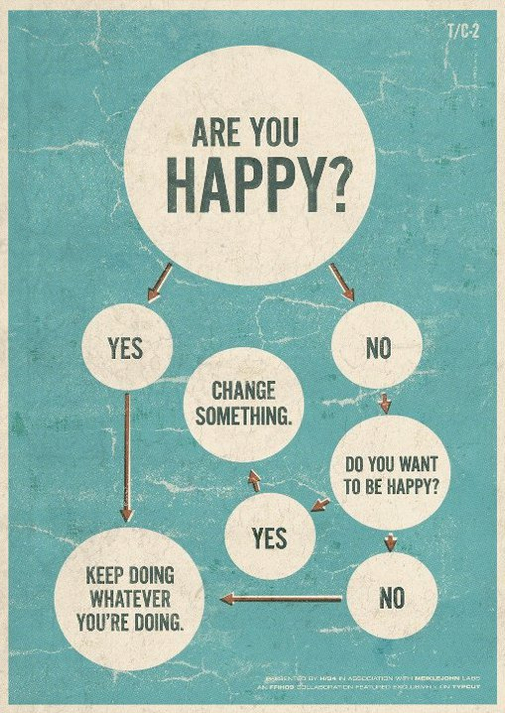
Things Real People Don’t Say About Advertising is a Tumblr-powered collection of cheesy stock photos poking fun at the world of advertising… and advertisers too-often disconnection with reality. It’s a breezy, easy site to scan, in much the same way as the Lolcats at I Can Has Cheezburger.

While it’s sure to make you smile, especially if you’ve been involved in advertising or even commercial web projects, TPDSAA has a very real point. Too often we miss the mark when trying to communicate. We spend too much time on minutiae, and make too many assumptions that “we” know what our audience wants because we think they are just like us.

We Are Not Our Audience

Whether “we” means an ad agency, design firm or an individual simply trying to stake their claim on the Internet, “we” are not the same as everyone else. In fact, everyone else is very different from us. We are too close to the subject to see it through the eyes of the average visitor.

Over and over I’ve heard anecdotes of people recruiting their mom as the ultimate usability tester. The assumption is, if mom gets it, everyone will. Honestly, this is not far from the truth. We need to interact. We need to be genuine. We need to ask — our visitors, employees, members or customers — what they really need and want. And then, we need to give it to them.

I’m not suggesting design by committee, or worse, design by community. There is still a need for vision and creativity. Our experience and knowledge can help create a user experience that delights. Doing so requires a combination of that know-how and a willingness to listen and adapt to genuinely serve the audience.

Check out TPDSAA. I guarantee you will find at least a few photos you’ll relate to. And if you’re in a position to influence user experience, think about how you can avoid ending up lampooned on TPDSAA.

Looking to improve user experience? Here’s two companies I recommend:

  • Adaptive Path provides a range of consulting services to help companies improve their user experience, as well as coordinating a series of events and conferences for user experience professionals.
  • Creative Good also provides consulting services for companies who want to improve the user experience, supplemented by councils — groups of peers sharing their knowledge and expertise. The annual GEL conference (Good Experience Live) draws a range of creatives in a format closer to TED than an typical conference.

Meantime, I’m thinking about how I can apply the humor of TPDSAA to the realm of knowledge management. Stay tuned…

Posted on 3 Comments

Fortune Cookies and the Chinese New Year

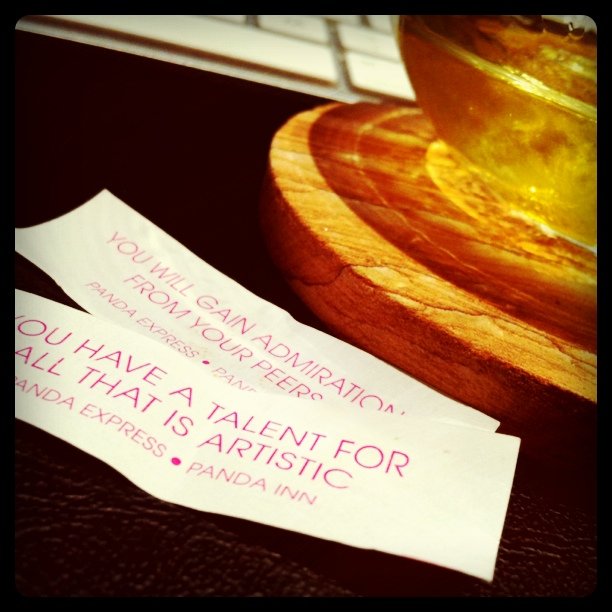
Today is the Chinese New Year (for a few more hours at least, here in California). This year will be the Year of the Rabbit. Naturally I was compelled to commemorate the auspicious occasion with a visit to that quintessential restaurant of Chinese cuisine, Panda Express. Well, maybe not so authentic, but it was quick and cheap, and it just so happen that they gave me not one but two fortune cookies.

Fortune cookies are fascinating. About 3 billion fortune cookies are made each year, and the vast majority are consumed in the United States. They are an american invention, a derivative of a Japanese cookie co-opted and popularized by Chinese Americans. You won’t find them in China. And you can even order cookies with custom fortunes, although that seems a bit deterministic.

Even more fascinating is the psychology behind our fascination with those flimsy little strips of paper with whimsical wisdom and prophesies. I don’t know anyone who takes them seriously, but at the same time, even people who don’t eat the cookies will break them open just to read their fortune.

I’ll admit that I read them as well, and sometimes I even forget to append the words “…in bed” at the end.

Some fortunes I enjoy, and others irritate me. But most of all, I wonder… who writes these things? Is someone locked up in a room somewhere knitting their brow as they try to come up with a new twist on fortunes? Have they parlayed this into a full-time career?

The short answers are: Donald Lau, yes and no.

The New Yorker ran a story on Mr. Lau back in 2005. Lau was vice-president of Wonton Food, Inc. where he managed the accounts payable and receivable, negotiated with insurers, and and composed the fortunes that went inside Wonton Food’s cookies.

It’s a role he fell into without intent. The noodle manufacturer he worked for expanded into fortune cookies, buying a plant on Long Island and along with it, it’s aging collection of fortunes (“Find someone as gay as you are.” read one fortune dating back to the 1940’s).

Lau was chosen not for his writing ability, but simply because his English was the best of the group.

The full story is still a great read.

And my fortune today? “You will gain admiration from your peers…”