
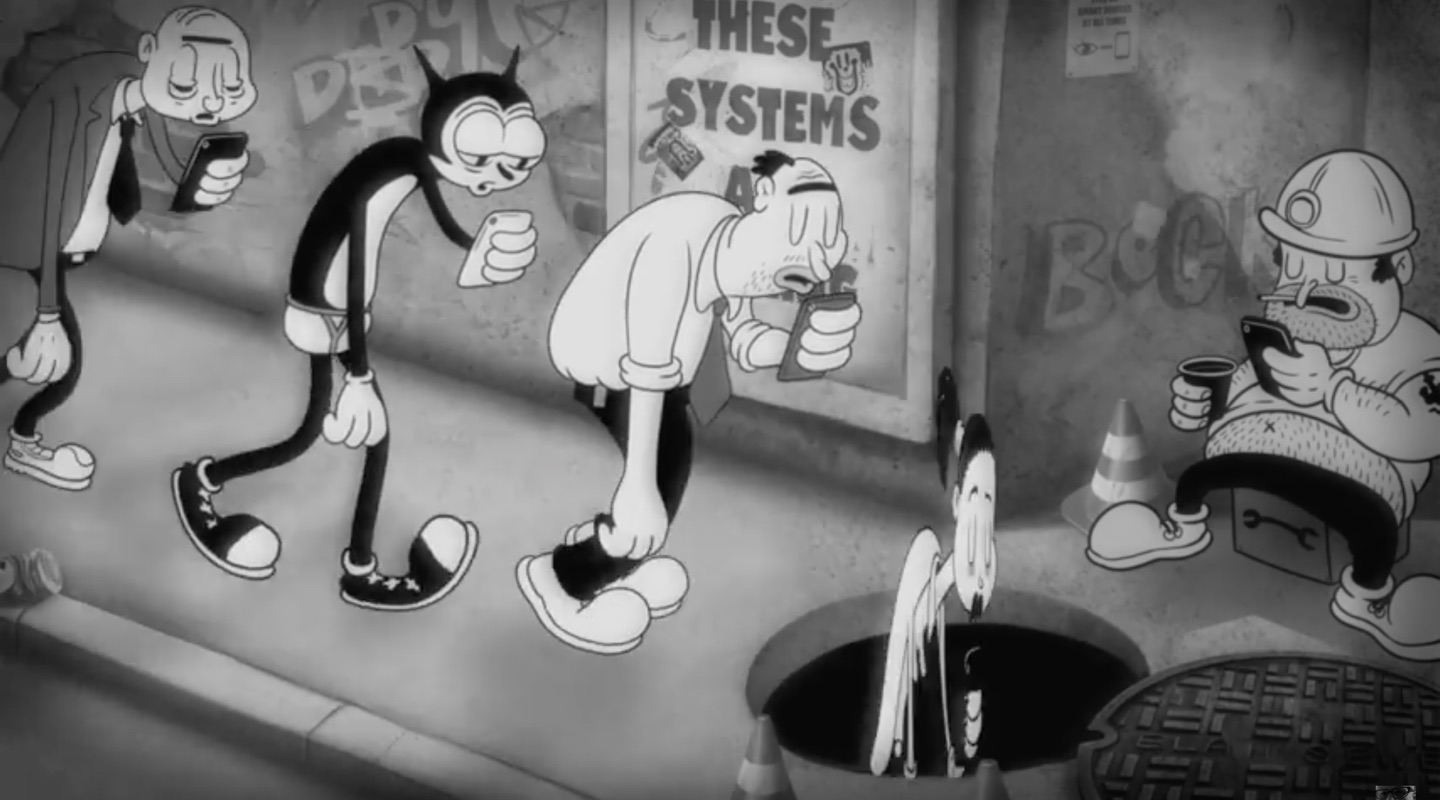
There’s a lot of talk these days about unplugging and disconnecting. This music video captures the problem quite well. We more connected than ever, and yet…
Love the old-timey animation from Steve Cutts. Now turn off your phone and take a hike.
There’s a lot of talk these days about unplugging and disconnecting. This music video captures the problem quite well. We more connected than ever, and yet…
Love the old-timey animation from Steve Cutts. Now turn off your phone and take a hike.

Recently, the staff where my wife works attended two days of training on the Seven Habits of Highly Effective People. One of the exercises she was given used an analogy of rocks and sand to represent time management.
Ah hah! I gave a presentation to that effect at a KM Summit back in 2006. I can fill in with some visuals, but instead of rocks and sand, I’ll use jawbreakers and M&Ms.
Rich or poor, young or old, we all have precisely 24 hours in a day, and seven days in our week. It’s what we do with those hours that distinguishes us.
To illustrate, consider the jawbreaker as that big, important task that Must Be Done. It’s probably not easy. You may not even particularly relish the idea of hunkering down and getting it done. But it’s there, along with a number of other Big Important Tasks.

The M&Ms are the small, urgent tasks. Sometimes they’re the little fires that break out during the day as you rush from stomping out the last one. They can be provide quick gratification as you tick off items in your to-do list, but they ultimately they are not as important as the jawbreakers.
Urgent? Perhaps. Do they help move you closer to your big goals? Not so much.
The mistake many of us make is that we start our day by succumbing to the tyranny of the urgent. The M&Ms. Why is that a problem? Try this exercise. It begins with a bowl-full of jawbreakers and a couple pounds of M&Ms.

If we take the M&Ms and pour it into our empty vase, and add the jawbreakers afterwards, you’ll find they won’t all fit. Our day planner runneth over.

Next, try putting all the jawbreakers–the Big Important Tasks–first. They all fit in the vase.

Finally, pour in the M&Ms and magically–they also fit–easily filling the empty spaces between the jawbreakers.

What are those urgent little tasks that are filling up your day? What are the Big Important Tasks that you never seem to have enough time to finish?
Brainstorm a few and inverting the priorities and you’ll make great strides toward reaching those big goals.

It’s been said that “time is money.” Technically, this is an inaccurate statement. If it were literally true, we would all be financially equal, as we all have the exact same number of hours in a day.
Time is money.
What’s really meant by the phrase is that time is valuable. Don’t waste my time. Get to the point.
If time were money, it stands to reason that money is time. Some might argue that it’s true. The more money one possesses, the more freedom to use time as one sees fit.
But what if it were literally true?
If you could buy additional hours in a day, how many would you buy, and what would you be willing to pay?
What would you do with your “extra” hours?
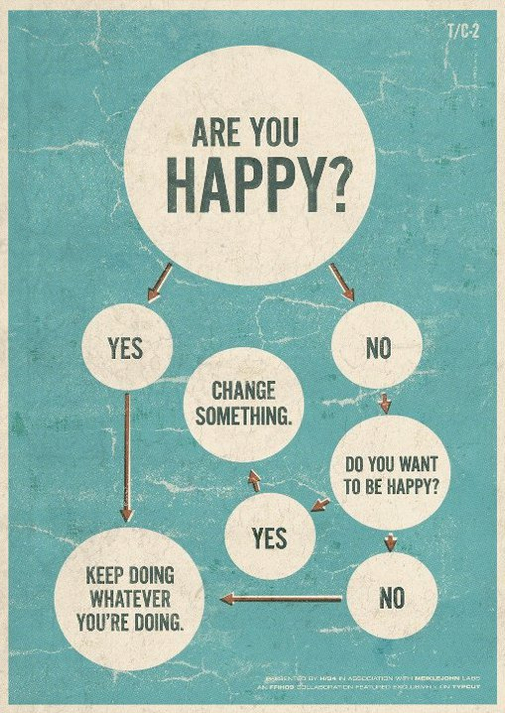

I grabbed this guide to happiness from Facebook. I couldn’t read the credits, so if you know who created this simple-but-truthful flow chart, please let me know.


The Daily Post challenge to write a post a day for 2011 has started a weekly photo challenge. This week’s theme is “boundaries.”
Boundaries surround us, some made by others, some of our own creation. Boundaries can protect us and help us manage our world. But sometimes it’s helpful to look at those boundaries from a fresh perspective. This boundary is beautiful with it’s layer grids, textures and perspective. They symmetry and design could easily be taken for granted or even go unnoticed, despite the fact that I pass through this boundary at least twice a day.
Beauty surrounds us, if we have eyes to see it.
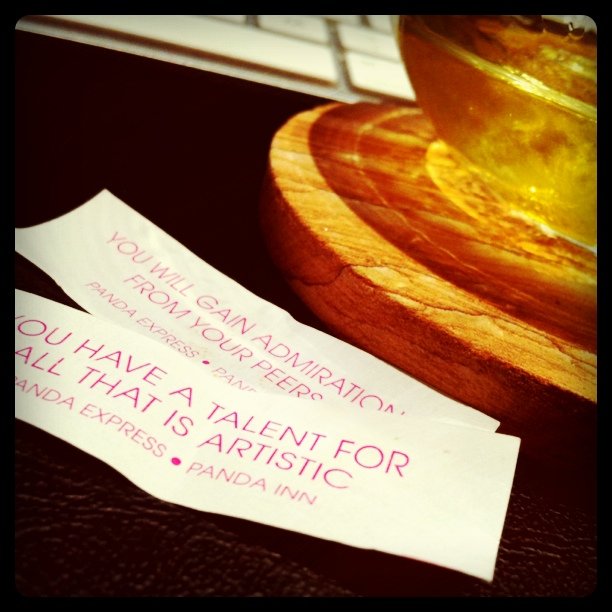

Today is the Chinese New Year (for a few more hours at least, here in California). This year will be the Year of the Rabbit. Naturally I was compelled to commemorate the auspicious occasion with a visit to that quintessential restaurant of Chinese cuisine, Panda Express. Well, maybe not so authentic, but it was quick and cheap, and it just so happen that they gave me not one but two fortune cookies.
Fortune cookies are fascinating. About 3 billion fortune cookies are made each year, and the vast majority are consumed in the United States. They are an american invention, a derivative of a Japanese cookie co-opted and popularized by Chinese Americans. You won’t find them in China. And you can even order cookies with custom fortunes, although that seems a bit deterministic.
Even more fascinating is the psychology behind our fascination with those flimsy little strips of paper with whimsical wisdom and prophesies. I don’t know anyone who takes them seriously, but at the same time, even people who don’t eat the cookies will break them open just to read their fortune.
I’ll admit that I read them as well, and sometimes I even forget to append the words “…in bed” at the end.
Some fortunes I enjoy, and others irritate me. But most of all, I wonder… who writes these things? Is someone locked up in a room somewhere knitting their brow as they try to come up with a new twist on fortunes? Have they parlayed this into a full-time career?
The short answers are: Donald Lau, yes and no.
The New Yorker ran a story on Mr. Lau back in 2005. Lau was vice-president of Wonton Food, Inc. where he managed the accounts payable and receivable, negotiated with insurers, and and composed the fortunes that went inside Wonton Food’s cookies.
It’s a role he fell into without intent. The noodle manufacturer he worked for expanded into fortune cookies, buying a plant on Long Island and along with it, it’s aging collection of fortunes (“Find someone as gay as you are.” read one fortune dating back to the 1940’s).
Lau was chosen not for his writing ability, but simply because his English was the best of the group.
The full story is still a great read.
And my fortune today? “You will gain admiration from your peers…”

Self-described change agent Seth Godin has put together a free e-book that I’d like to share with you. What Matters Now is a compilation of one page essays by over seventy notable authors.
One of my favorites was titled “Gumption” by novelist J.C. Hutchins. His message, like many contained in the book, is well-timed and thought provoking end-of-the-year reading.
Most of us settle in, and settle for what we have. Rather than pursue, we accept. Our lives become unwitting celebrations of passivity: we undervalue our work and perceive ourselves as wage slaves (and so we phone it in at the day gig), we consume compulsively (but not create), we pine for better lives (but live vicariously through our televisions).
These corners we paint ourselves into, it’s no way to live. There’s no adventure here, no passion, no hunger for change. Remember that relentless optimism you once had? The goals you wished to achieve, before settling in? They’re still there. You need a nudge to find them; a little gumption.
You can start that business. You can lose that weight. You can quit smoking, and learn to garden, and write that book, and be a better parent, and be all the things you want to be … the thing this world needs you to be. It requires courage and faith, both of which you can muster. It requires effort — but this effortless life isn’t as satisfying as it seems, is it?
Declare war on passivity. Hush the inner voice that insists you’re over the hill, past your prime, unworthy of attaining those dreams. Disbelief is now the enemy, as is the notion of settling. Get hungry — hyena hungry. Get fired up. Find your backbone, and your wings.
Flap ‘em. It’s the only way you’ll be able to fly.