Posted on 1 Comment

Weekly Photo Challenge: Boundaries

The Daily Post challenge to write a post a day for 2011 has started a weekly photo challenge. This week’s theme is “boundaries.”

Boundaries surround us, some made by others, some of our own creation. Boundaries can protect us and help us manage our world. But sometimes it’s helpful to look at those boundaries from a fresh perspective. This boundary is beautiful with it’s layer grids, textures and perspective. They symmetry and design could easily be taken for granted or even go unnoticed, despite the fact that I pass through this boundary at least twice a day.

Beauty surrounds us, if we have eyes to see it.

Posted on 4 Comments

LunaTik & TikTok Unboxed

LunaTik and TikTok are a pair of wrist bands specifically designed to turn your iPod Nano into a multi-touch wrist watch. These beautiful watch straps were designed by Scott Wilson, former creative director at Nike Watches and founder of the Minimal design studio. They are beautifully designed and perfectly matched to the Nano. The best complement I can make is that if Apple designed a wrist band for the iPod Nano, it would probably look like this.

What really makes this band interesting was the way Scott and the Minimal team developed it. They had a great idea for converting the iPod Nano into a multi-touch watch, and to raise the capital they needed to take the bands from concept to production, they turned to Kickstarter. Kickstarter  allows people with an idea for a product, production or service to recruit micro-investments. The “investors” give a few bucks (or more), and rather than getting a share of ownership, they get the satisfaction of supporting someone with a great idea achieve their dream. And in some cases (as with TikTok and LunaTik) you get something in exchange.

Scott smartly put together great donor levels incentives. Pledge $25 or more and get a TikTok band. Pledge $50 or more and you got a LunaTik iPod Nano watch conversion kit. For $70 or more you got both. There were even bigger, fancier packages. In Scott’s case, their goal was to raise $15,000 — the minimum they felt they needed to justify the cost of going to production. They set a pledge deadline of December 16, but the response surprised them.

In the end, 13, 512 backers pledged a total of $941,718!

Needless to say, the project was a success, not only for Scott Wilson and Minimal, but for Kickstarter as well. Not that it wasn’t without some bumps in the road. Fulfillment was fraught with problems, as it turned out Kickstarter allowed people to pledge money without giving full addresses — obviously necessary for those getting the watch bands.

Scott did a great job of keeping the backers up to date with regular emails outlining the progress. He included photos as he travelled to China to meet with the manufacturer and shared videos of the bands being made.

A few notes about TikTok and LunaTik

  • The are designed to work with the 6th generation iPod Nano (the current model, as of Feb. 2011).
  • The iPod Nano is not included.
  • It is super easy to remove the iPod Nano from the TikTok. Snap it in; snap it out.
  • The LunaTik, on the other hand, is accurately labeled a watch conversion kit. While you can technically take your iPod Nano back out, it takes a couple special tools and some time.
  • They are big, but there are bigger watches out there. It’s definitely more of a man-sized watch though (sorry ladies).

The final product? See for yourself. Click any image below for a larger version.

Check out other projects on Kickstarter, learn what else Minimal has been designing, and if you’re interested in the LunaTik and TikTok watch bands, you can find out more at LunaTik.com.

One Last Thought

Someone is probably wondering why I would need both a LunaTik and a TikTok band, after all, I only have on iPod Nano. The reality is, I do not need both. I am thinking of a clever way to give one away. If you’ve got any ideas, leave me a comment!

Posted on 3 Comments

Fortune Cookies and the Chinese New Year

Today is the Chinese New Year (for a few more hours at least, here in California). This year will be the Year of the Rabbit. Naturally I was compelled to commemorate the auspicious occasion with a visit to that quintessential restaurant of Chinese cuisine, Panda Express. Well, maybe not so authentic, but it was quick and cheap, and it just so happen that they gave me not one but two fortune cookies.

Fortune cookies are fascinating. About 3 billion fortune cookies are made each year, and the vast majority are consumed in the United States. They are an american invention, a derivative of a Japanese cookie co-opted and popularized by Chinese Americans. You won’t find them in China. And you can even order cookies with custom fortunes, although that seems a bit deterministic.

Even more fascinating is the psychology behind our fascination with those flimsy little strips of paper with whimsical wisdom and prophesies. I don’t know anyone who takes them seriously, but at the same time, even people who don’t eat the cookies will break them open just to read their fortune.

I’ll admit that I read them as well, and sometimes I even forget to append the words “…in bed” at the end.

Some fortunes I enjoy, and others irritate me. But most of all, I wonder… who writes these things? Is someone locked up in a room somewhere knitting their brow as they try to come up with a new twist on fortunes? Have they parlayed this into a full-time career?

The short answers are: Donald Lau, yes and no.

The New Yorker ran a story on Mr. Lau back in 2005. Lau was vice-president of Wonton Food, Inc. where he managed the accounts payable and receivable, negotiated with insurers, and and composed the fortunes that went inside Wonton Food’s cookies.

It’s a role he fell into without intent. The noodle manufacturer he worked for expanded into fortune cookies, buying a plant on Long Island and along with it, it’s aging collection of fortunes (“Find someone as gay as you are.” read one fortune dating back to the 1940’s).

Lau was chosen not for his writing ability, but simply because his English was the best of the group.

The full story is still a great read.

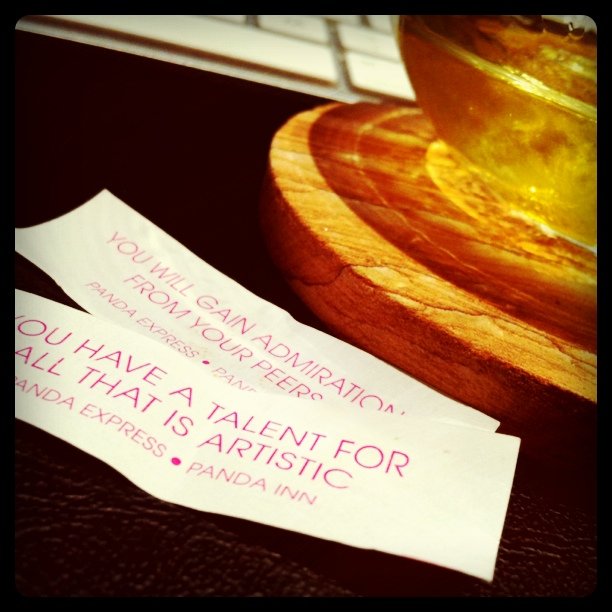
And my fortune today? “You will gain admiration from your peers…”

Posted on 5 Comments

Managing Your Editorial Calendar in WordPress

I can see the headline now: “Time travel is now a reality,” says leading WordPress scientist.

One of the features that many people either 1. never learned about or 2. forget that it is there is the ability to schedule posts for publication at a specific date and time.

By default, when you initially publish a post or page, or save a draft, WordPress will grab the current date and time and use this as the publication date. You can override this to either back-date a post or post date for future publishing. This is great for scheduling posts when you know you want to announce something when you will be offline, or when you need to embargo information until a particular time.

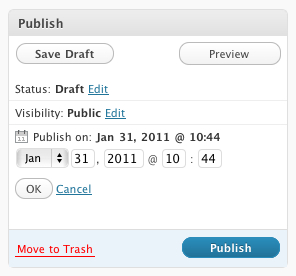
To change the publish date, simply click the edit link in the Publish block and you’ll gave options to set the month, day, year and time of the post. Yes, time travel really is possible.

Note that if you select a date in the future, the Publish button smartly changes to a Schedule button. Pretty clever.

If you are going for consistency over time, another great tool is the Editorial Calendar plugin available in the WordPress plugin repository. This adds a new Calendar link in your Posts menu, which then displays a scrollable calendar showing all your posts plotted over it. From here you can add new posts, schedule posts for future publication and get a clear picture of when articles need to be ready. Here’s a screencast from the plugin author Zack Grossbart that shows all the bells and whistles.

I’m using this more and more as I add rigor to my publishing schedule as part of my project for 365 posts in 365 days. I’m able to slot in topics that I know I want to cover, and do it on a timeline that makes sense. I can collect my thoughts in a draft mode, then polish up the post before publication. If I finish early, I just schedule the post to go live on the selected date.

What tips and techniques do you use to manage your editorial calendar?

Posted on 3 Comments

U.S. Speed Sport Goes Live

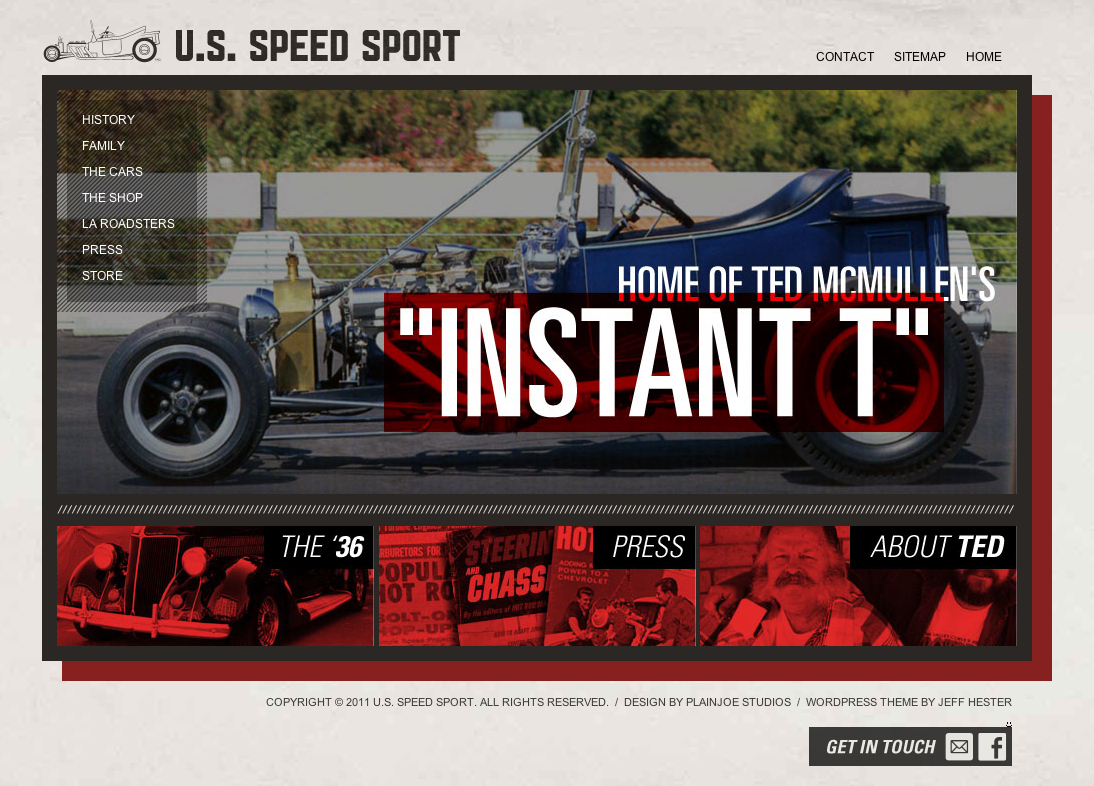
One of my latest projects went live this weekend. U.S. Speed Sport is devoted to the memory of one of the pioneers of hot rodding, Ted McMullen and his company U.S. Speed Sport.

It’s a WordPress powered site using a custom theme I built on the Studiopress Genesis framework. Why build on the Genesis framework? Genesis provides strong search engine optimization out-of-the-box, dead-simple WordPress upgrades and a great set of core widgets. Now the client can add pages, customize menus and change images on the homepage or headers without requiring a developer.

U.S. Speed Sport also uses Gravity Forms for intelligent form design and handling, and Slickr Flickr to integrate photo galleries hosted on Flickr.

Check out U.S. Speed Sport.

Posted on Leave a comment

Seth Godin Returns to Orange County

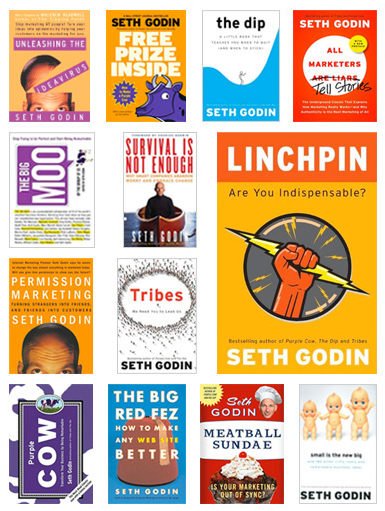
Seth Godin is coming to Orange County! Godin’s twelve books — all of them bestsellers — deal with the post-industrial revolution, the way ideas spread, marketing, quitting, leadership and most of all, changing everything. His blog is considered the most popular marketing blog in the world. And he’s coming to Orange County and you can hear him speak.

On March 2, Seth will be speaking at Renée and Henry Segerstrom Concert Hall. The event — organized by Bryan Elliot as part of Linked Orange County — is a great opportunity to hear from the innovative thought leader who usually is only seen at exclusive events like TED. Tickets are available now, and this is likely to sell out.

I’ve read several of his books, including The Big Moo, Small is the New Big, and Linchpin. He has a way of cutting through the crap and addressing your customer (be they internal or external) in a whole new way. Check out all of Seth Godin’s books (affiliate link).

What’s your take on Seth Godin? Let me know if you going on March 2, and I’ll make a point to say hello.

Posted on Leave a comment

Meet Me at WordCamp San Francisco

This year WordCamp San Francisco celebrates it’s fifth anniversary. I attended the first WordCamp SF way back in 2007. It was a much more intimate affair back then, and the sense of community was unmistakable.

Five years later, the event has grown to three days, and a much bigger venue than that humble beginning. The dates for WordCamp SF and venue have been confirmed: August 12-14 at the Mission Bay Conference Center. According to Jane Wells, the tentative plan is to focus programming for publishers on Friday, bloggers on Saturday, and developers on Sunday.

Who should go to WordCamp SF?

If you work with WordPress, whether for your own sites or clients, WordCamp provides a unique opportunity for intensive learning and community building. You’ll rub elbows with others who love and use WordPress, everyone from designers and developers to small-time bloggers and big corporate names (yes, they use WordPress too!).

The first ever WordCamp SF back in 2007

WordCamp SF is the biggest and original WordCamp, and is where Automattic’s Matt Mullenweg delivers his annual State of the Word address. WordCamp SF is different from the many excellent local WordCamps. While the local events generally focus more exclusively on WordPress, the San Francisco event pulls in some big name speakers talking about bigger topics.

I highly recommend attending a local WordCamp for the intensive learning and networking opportunity with local WordPress folks. For me, I attend WordCamp OC (I helped Brandon Dove and Jeffrey Zinn of Pixel Jar organize last year) and WordCamp LA. This year, I’ll probably be found at WordCamp San Diego, too.

Another great local option? Check out Meetup.com for local WordPress user groups. We are fortunate here in Orange County to have a very active group organized by Jeff Turner and Steve Zehngut of Zeek Interactive.

If you can swing the trip to San Francisco, also attend WordCamp SF for the inside scoop and the inspiration. It’s a big event, and like any big conference, it helps to network with other attendees before you go to make the most of the trip.

You can find a complete list of local WordCamp events at WordCamp Central. For instance, this very weekend there’s WordCamp Phoenix (Hey guys, look forward to hearing all about it!).

Mark your calendars for WordCamp SF, and be sure to let me know if you are planning on attending. We’ll meet up for a cold beverage!