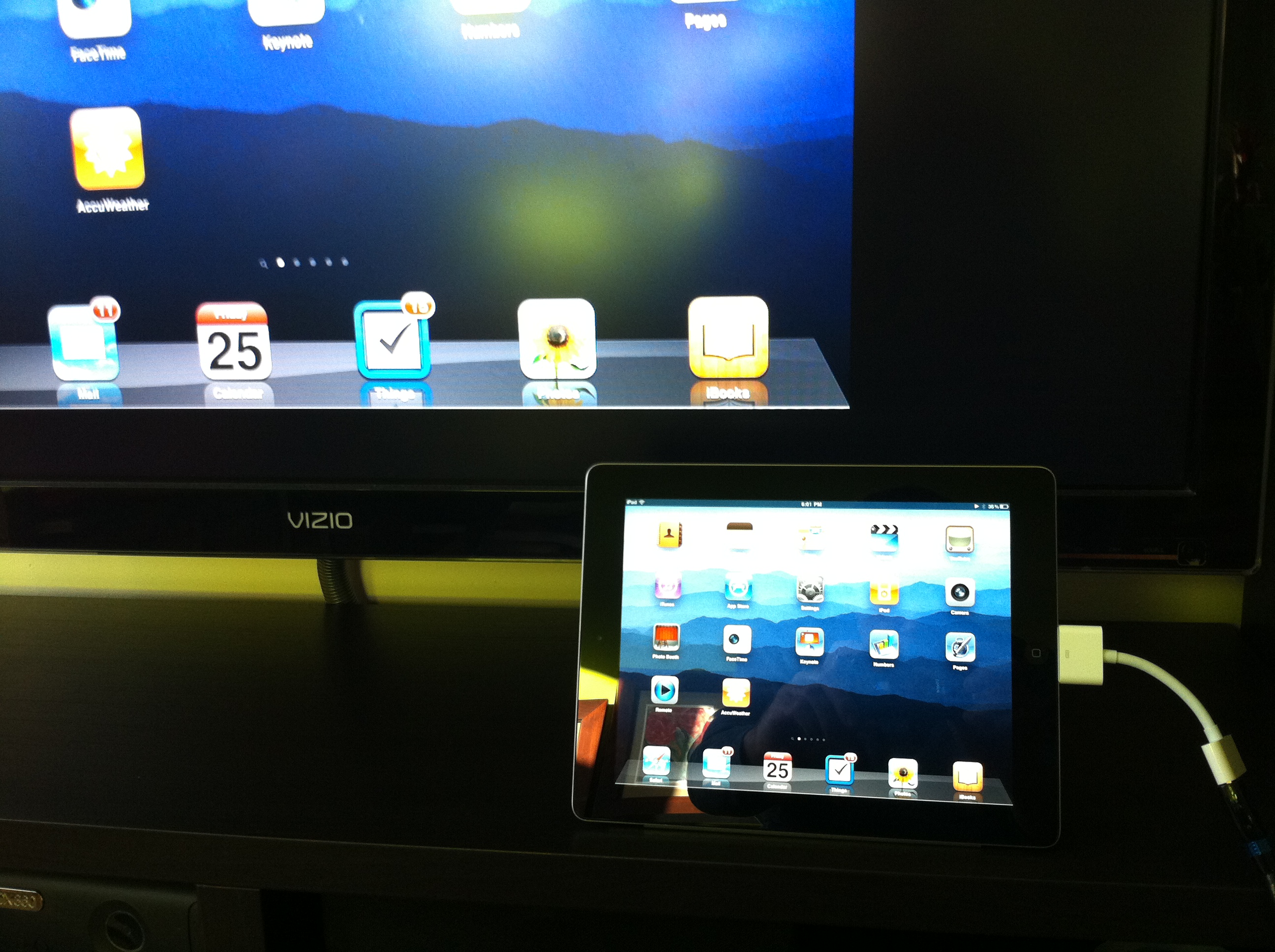
When I got my iPad last October, I was astounded that there was no way to mirror your display to a larger screen. This seems like a no-brainer — for training or even demo purposes, you would think that Apple would have some way to mirror the display to an external monitor or LCD screen. I researched this extensively and even talked to the geniuses at the Apple Store. Everything pointed to the same answer: it simply wasn’t possible.
My iPad display mirrored on the Visio TV
The closest thing to it was the A/V cable, which allowed you to output some video streams to an external display. The built-in video player, the YouTube and Netflix apps all supported this feature. This was nice, but it still didn’t give you a way to mirror what you saw on your iPad — an essential capability if you want to demo an app (for example) to an audience.
Fortunately, this is one of the features the iPad 2 supports. It does require the new Apple Digital A/V Adapter ($39) and an HDMI cable. With this, I’m now able to mirror the display of my iPad to my 47″ Visio flatscreen TV and pipe everything through my Pioneer VSX-820 amp.
I’ll be using this at upcoming meetings in the very near future.
Earlier this week, LinkedIn registered their 100 millionth member. They are currently registering a new member at the rate of one per second. While the number still lags behind Facebook, it is a significant milestone and shows strong growth for the professional networking service.
I first heard about the milestone when I received (along with a million others) the following email from Reid Hoffman, co-founder and chairman of LinkedIn:
Dear Jeff,
I want to personally thank you because you were one of LinkedIn’s first million members (member number 548570 in fact!*). In any technology adoption lifecycle, there are the early adopters, those who help lead the way. That was you.
When we founded LinkedIn, our vision was to help the world’s professionals be more successful and productive. Today, with your help, LinkedIn is changing the lives of millions of members by helping them connect with others, find jobs, get insights, start a business, and much more.
We are grateful for your support and look forward to helping you accomplish much more in the years to come. I hope that you are having a great year.
Honestly, I have not been a very active LinkedIn user until recently, and I am still learning the ropes. But if you haven’t checked it out, it’s probably time for a fresh look. That’s why I’ve signed up for Neal Schaffer‘s upcoming LinkedIn Workshop on April 19th at SMMOC Labs.
Neal is an recognized LinkedIn expert and author of Understanding, Leveraging and Maximizing LinkedIn. He held a similar workshop back in the fall and got rave reviews. It’s a hands-on workshop — bring your laptop and be prepared to take specific steps that will help you get more value from LinkedIn. Join me there, and feel free to connect with me on LinkedIn.
So What Does 100 Million Members Look Like?
Here is a great infographic that illustrates what 100,000,000 members looks like.
It’s been five years since Twitter co-founder Jack Dorsey officially sent the first tweet.
At the time, Twitter was a side project at Odeo (which it has grown to eclipse). I dug back into the archives and found my first blog post about Twitter, from February 15, 2007.
At the time, Twitter was officially described as “…a community of friends and strangers from around the world sending updates about moments in their lives. Friends near or far can use Twitter to remain somewhat close while far away. Curious people can make friends. Bloggers can use it as a mini-blogging tool. Developers can use the API to make Twitter tools of their own. Possibilities are endless!”
I had been using Twitter since the fall of 2006, but actually (and unfortunately) closed my account in 2008 (losing over a thousand tweets and thousands of followers). Eight months later, I was ready to give Twitter another try. As you can see from this Birthday video, I’m not alone.
Incidentally, you can see a full list of all the people from that video with links to follow (if you’re so inclined) here.
Twitter has grown and evolved over the past five years. How long have you been using Twitter? How has it changed how you connect with your world?
Last month, I shared how face-to-face meetings still matter. You might assume that the realm of social media — which by it’s very definition encourages online community and relationship building — wouldn’t really gain much through real life interaction. You’d be dead wrong.
Social Media in the Real OC
Scott Stratton at LinkedOC
Here in Orange County we are fortunate to have a thriving social media community, supported by a number of regular, live events. Bryan Elliot’s LinkedOC leverages LinkedIn and holds monthly networking events with great speakers such as Scott Stratton and Seth Godin. These are big events, but you meet a number of interesting people who are building their tribe. LinkedOC lies somewhere between a social media group and an old school networking meeting.
My favorite event remains Bob Watson’s Social Media Masterminds of Orange County — or simply SMMOC. This group meets nearly every week on Saturday mornings from 9-11am in Costa Mesa, and draws a wide range of people with an interest in social media — from consultants to mommy bloggers and real estate professionals to enthusiasts.
The whiteboard at SMMOC. Click to enlarge.
The agenda is flexible. There is no projector or monitor, but there is wifi in the room. Attendees are free to use the whiteboard to write down discussion topics or share their Twitter handle. Bob is a terrific facilitator, deftly leading the group through two hours of fantastic interaction and learning. There are just three rules: no self-promotion, no acronyms (at least, not without a definition) and there are no dumb questions.
This group is up on the latest happenings in the social media realm, so whether you’re new to social media or an old pro (what defines someone as an old pro in social media??), you will learn and grow from the discussion. But the real value is in the relationships that are made and bonded through the face-to-face interaction.
These people have helped me refine how I use social media, encouraged me to improve my blogging and helped me stay on top of the ever-changing social media landscape. My life is richer for the relationships.
Can you develop community and relationships entirely using social media alone? Certainly, but real-world face time strengthens those connections and accelerates the process.
How are face-to-face interactions helping strengthen your social and professional network?
I’ve been using Foursquaresince their iPhone app first came out. The promise of Foursquare has yet to be fulfilled (for me), mainly because the demographic is so specific. You’ve got to have a smart phone (which used to be more of an issue than it is today). You and your friends have to care enough to bother checking in. And it helps to be located nearby. All this conspires to make Foursquare well suited for urban environs like NYC or San Francisco, or tech-saavy events like SXSW. Orange County is still a little too sleepy to realize the full potential of Foursquare.
That may be changing.
The most recent update to Foursquare incorporated a leaderboard. You could always compete on Foursquare with your friends for badges or mayorship of the local Starbucks, but the leaderboard brings a whole new level of competition to the “game” of Foursquare.
I upgraded to the new version as soon as it came out — I’m religious about upgrading. But I didn’t really pay much attention to the new features. The most obvious new feature was the “Specials Nearby” which now shows the number and a list of all specials within a few miles of your current location.
When I checked in, I also noticed it showed my current rank, but I still didn’t pay much attention to that. Then I noticed some unusual check-in behavior. Pete McGowan — one of my friends at PlainJoe Studios — was checking in all over the place. He even checked in from the 15 freeway! Weird, right?
Ranked #7 at the moment
Then I stumbled upon the reason. Clicking on the leaderboard from your profile shows your rank next to all of your Foursquare friends. The gauntlet had been thrown down, and it seemed that — at least for some people — they were determined to sit at the top of that leaderboard.
#1 has over 300 check-in points!
My girlfriend will tell you I check in a lot. She marvels at my consistency, but really it’s just a matter of habit now. I figured I’d rank pretty high, which I do, but when you look at my total check-in points, it’s a fraction of those of my friend Pete.
It’s possible that some people are abusing their check-in powers just to game the system. But it’s also clear that Foursquare has taken the game aspect of their popular app to a whole new level.
Jeff Turner shared his thoughts on transparency this week, and spurred me to tackle a subject that I’ve been mulling over for a long while.
There’s a lot that’s been said about transparency, authenticity, honesty and being genuine. Social media experts will advise you that if you represent a company of any size, you can tweet, comment and post, but you need to do so with a personal voice. Generally, it’s true; people can smell bullshit from a mile away, especially the glossy, corporate marketing-speak kind.
What people respect and are attracted to is the real deal; people who are comfortable being themselves. So what does that mean.
Inevitably in these discussions about authenticity, someone will bring up a blogger like Dooce — aka Heather B. Armstrong. The New York Times declared Heather the “Queen of the Mommy Bloggers” for her ability to parlay her blog into a full-time business with three employees. Heather’s trademark style is brash. She lays it all out there, whatever is on her mind. You get profanity. Struggles with substances. Martial strife. And good stuff, too.
So should all bloggers should be similarly “transparent” about their lives? Hell no! But we must be genuine. What does that look like? It can be confusing, because people toss around these words as if they were interchangeable:
Transparency implies openness, communication and accountability. It does not imply (ore require) that you share every little detail and thought that races around between your ears.
Authenticity is the quality of being believable or trustworthy.
Honesty is simply being truthful. As with transparency, you can be truthful without oversharing.
Genuine means “possessing the claimed or attributed character, quality, or origin; not counterfeit.”
While they are all cousins, they are not the same.
Clearly (hah!) transparency involves being genuine, but the degree of transparency you is a factor of how comfortable you are sharing your innermost self. An obvious one: do you feel “safe” sharing your social security number on your blog? Most people will agree that is not a level of transparency they aspire to.
The goal then is not 100% transparency, but a comfortable degree of translucency.
Be genuine. Be yourself.
Over time, people will know who you are, what you really stand for, and whether they can really trust you.
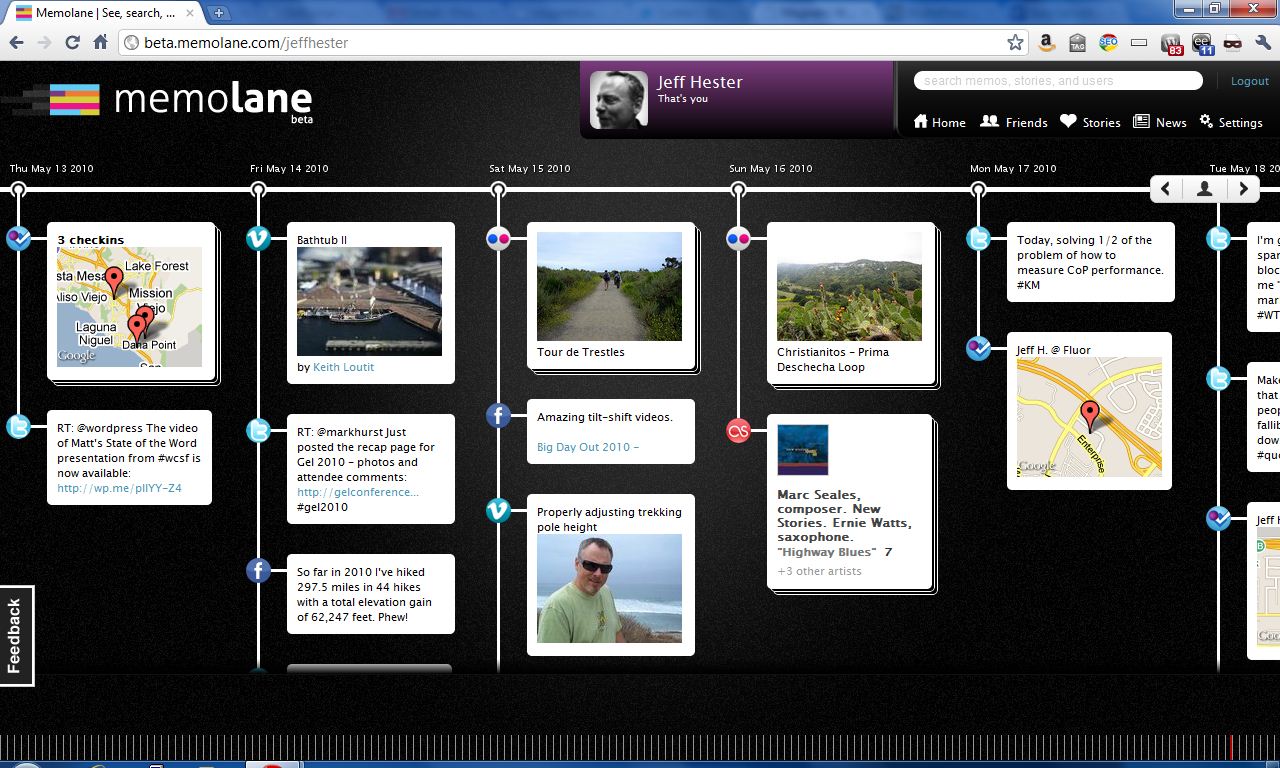
It’s been said that everything you do or say on the Internet is there for ever. But even with all the various websites and services we use, it’s still not easy to collect all those tweets, posts, photos and other artifacts in a organized way. Flavors.me does a fair job of aggregating this data, and Facebook is doing more and more aggregation. But neither of these attempt to take a historical look back at your activity. This is where Memolane attempts to fill the gap, creating a digital timeline of your contributions.
Currently in beta, Memolane allows users to configure a variety of popular services and then automatically collects them in a timeline. The services supported include Facebook, Twitter, Flickr, Last.fm, Picasa, RSS feeds, YouTube, Vimeo, Foursquare and TripIt, with support for additional services promised.
The results are pretty amazing. You can scroll back through time and see where you checked in, what you tweeted, what photos you posted and so on. Across the bottom of the screen is a series of vertical lines that represent a granular view of time that lets you quickly scroll through years of data. Slick!
You have control over whether you share this publicly or not, but I noticed some glitches. For instance, if you have photos marked private on Flickr, they still come over into your Memolane timeline. Depending on your Memonlane settings, they may be visible in your “lane” regardless of your Flickr settings. Not great, but then it’s still in beta.
Memolane Community Manager Meghan Krane graciously gave me an invite code to share with you (thanks, Meghan!). If you’d like to try Memolane for yourself, sign-up here using the invite code “hester”.



 Jeff Turner shared