Posted on 3 Comments

Knowledge Management is Not a Software Solution

At Fluor, one of our favorite sayings about knowledge management is that “KM is not about the tool!” We aren’t Luddites by any means. Ineffective tools can inhibit the success of KM, just as woodworker would struggle with a dull blade.

Conversing with our colleagues at other companies, participating in best practice studies with APQC, through industry KM groups and informal discussions with other KM professionals — both inside our industry and beyond — have reaffirmed this point.

Technology is not a critical factor to successful knowledge management.

Today on Nick Milton’s Knoco stories blog, he poses the question: What was KM like, before IT?  How did we manage knowledge in medieval times? A provocative concept, since so many people immediately jump to technology when thinking of KM.

Overwhelmingly, the organizations that struggle to achieve success with KM do so because of this inappropriate focus on technology. The theory goes, “if only we had SharePoint (or Yammer, or Wikis, or fill-in-the-blank), sharing knowledge would be easy.”

And it’s true, to a point. Today, we have an abundance of tools that do indeed make it easier to share our knowledge, and many of them are excellent. We don’t have a technology problem.

It’s the difficult part that people either overlook or give inadequate emphasis; the soft part… people.

For KM to deliver value to an organization, the people who possess the knowledge and the people that need the knowledge need to connect. The right behaviors, motivators and a culture of collaboration and knowledge sharing needs to be nurtured. Leaders must determine how they can weave these principles into their work process, or transform those processes completely in ways that deliver value and ultimately supports the organization’s strategic vision.

This has implications that reach far beyond knowledge management. If you examine the success of Twitter, Facebook and LinkedIn, you’ll find that the people who get the most out of them are not necessarily the most sophisticated techno-geeks, nor the ones with the most “friends.” They are the ones who use technology to help them build and strengthen relationships — be they personal or professional. Once again, “it’s the people.”

I share this to remind myself, as well as stimulating one or two you. Tomorrow I’ll be training four, bright new knowledge managers. On this, their third day of training, we will be looking at (you guessed it) the tool.

Personally, I love tools. They can be a godsend, and enable global collaboration in a way that wasn’t possible when I began my career. But just as it’s not possession of the tools that makes a master craftsman, success in KM has far more to do with people and process.

Photo credit: Hans Splinter

Posted on 9 Comments

Twitter Basics: Dealing with Spammers

As Twitter grows in popularity, it’s inevitable that some people will abuse the system. Plenty of people out there promote themselves or their company on Twitter. I’m fine with that, as long as it’s done well (Zappos is an example that comes to mind). But increasingly, unscrupulous “marketers” are using automated services and programs with the intent of building lists of followers in hopes of promoting a service or business (or sometimes, a wide range of businesses).

Here’s how to detect a Twitter spammer and what you can do to help stop them.

Watch your new followers carefully. I get email notifications of new followers. This morning in my inbox I had a number of new followers in quick succession.

That the first tip-off: a cluster of new followers in a very short period of time.

Opening one of the emails, I noticed something unusual. The email shows what tool they used to follow you — TweetDeck, Co-Tweet, etc. — but in this case, “Hazel G” followed me using angulate leafhopper. Hmmm… smells like B.S. to me. Sure enough, the link went to the website of a limo service in NYC.

Looking at the number of tweets (zero), I can tell right from this email that this isn’t a real person at all. No need to check their profile. Click the report Hazel G for spam link to notify Twitter that this non-person is actually controlled by a spammer.

You might not be configured to receive email notifications of new followers. Instead, you can view your followers and see who’s new. A quick look and it’s easy to see more clues that they are a spammer.

In this case, Hazel’s bio offers further clues. First of all, she doesn’t look like the sort of woman who would call herself an “iPhoneSlut” nor does she look like she’s into hip-hop (no offense to middle-aged white women who love hip-hop).  Sometimes I wish the spammers would at least do a little more work creating their fictitious identities. The current results are hilarious. And it gets better. Consider “Ernest”:

Ernest must curse the day her parents have her a guy’s name. Maybe that’s what drove her to become a punk rock, high fashion hippie.

I thought that was strange combination of interests, but apparently it’s much more common than I thought!

What kismet! Elizabeth is also a punk rocking, high fashion hippie who is saving the world. Maybe they were separated at birth (by more than 20 years?).

At any rate, you get the point. It’s not hard to spot a spammer. So what how do you handle them? Report them to Twitter:

This will block them from following you (which could possibly mislead your real followers) and notifies Twitter of abuse. They get enough of these, and Elizabeth’s account gets suspended.

The Bottom Line

What’s the lesson here?

  1. Don’t auto-follow people who follow you. Although it takes more curation to vett followers manually, the net result is higher quality communication and less noise. Your goal with Twitter should never be to collect the most followers, but to build relationships with people who matter to you.
  2. Report the spammers. If we all do this regularly and consistently, it will improve the Twitterverse for everyone. It only takes a click!

I’ve seen a number of people recently using TrueTwit. This sends new followers a direct message asking them to verify that they are a human via a CAPTCHA. Personally, I find this a nuisance, but I understand why some people resort to such a service.

What tools and techniques do you use to stop Twitter spam?

Posted on 3 Comments

Gaming, Circa 1974

As long as I can remember, this simply designed wooden game sat on the coffee table in my grandparents living room. Growing up, I loved playing the game with my grandpa and grandma. The gameplay was simple. You spun the top, hoping it knocked the eight wooden balls into the eight divots. Each divot had a point value. Once the top stopped, you added up your score. Your opponent took their turn, and you repeated until you were tired of playing or dinner time arrived — whichever came first. Dinner usually won.

This was all long before the age of Mortal Kombat, World of Warcraft and even before the Internet (as we know it today). I didn’t care (not that I knew better). The game was just fun!

My grandparents have both since passed on, and the game now sits on my coffee table, in my living room. And the game still makes me smile. Partly, it’s the memories that it brings me. But a big part is the simple joy of a well-designed game. No batteries required.

Sometimes in life, it’s the simple things that bring us joy.

I shot these photos with my iPhone 4 mounted on a GorillaMobile tripod. To capture the motion of the spinning top, I used the Slow Shutter Cam app. I created the collage with Diptic and stylized it to give it a “70’s” look and uploaded with Instagram. I’m really pleased with the results.

Sometimes in life, it’s the complex things that bring us joy.


Posted on 3 Comments

Translation? There’s an App for That

Translation has long been a tough thing to do with any degree of accuracy. Remember “All your base are belong to us?

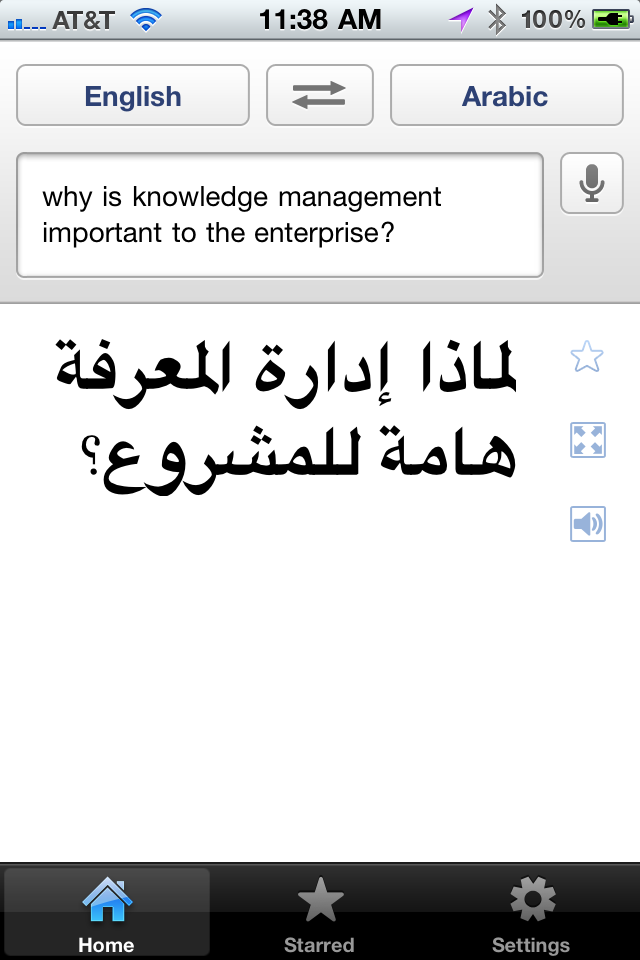
When Google Translate was introduced on the web years ago, it was an impressive and useful tool — even if it didn’t do a perfect job. Well the tools have progressed. Google Translate on the web added the ability to not only read the translation, but hear it spoken.

Of course, the missing bit in all of this is mobility. When you’re traveling abroad and speak just enough to eek by, it’s helpful to have a phrase book or dictionary. Or it was. Now Google has effectively rendered all those dedicated translator devices, phrasebooks and dictionaries obsolete. All you need now is an iPhone (or Android… I’m told) and their Google Translate app.

The new app offers several nice features. First, you don’t need to type. Just speak into the phone, select the language you want it translated to, and the app will show you the translated text. Google Translate on the iPhone supports voice input for 15 languages, translation into more than 50 languages, and you can hear the phrase spoken in 23 supported languages.

You can also hit a button to display the translated phrase full screen, to show to your taxi driver or waiter, for instance. And instead of spending a bundle of money on a dedicated translator device, you can get this app (it’s free) and use the savings on your trip!

There is one important caveat. The Google Translate requires an Internet connection. I tested it over both wifi and 3G, and it worked fine, including listening to the translated phrase in the target language. But this is becoming less and less of an issue. I’ve used my iPhone all over the world, from Chile to Abu Dhabi and throughout Europe with no problem.

Cette application va être utile quand je Voyage à Paris plus tard cette année!

Posted on Leave a comment

APQC 2011 Knowledge Management Conference

Larry Prusak speaking at the 2010 APQC KM Conference

Knowledge Management (KM) is a phrase that confounds many. Many companies and organizations that attempt to “manage their knowledge” fail miserably. The problem, it seems, is not so much with the concept as it is the terminology.

Simply put, knowledge management is a systematic approach to helping people share knowledge with each other. My friends at Shell sum it up with the  succinct phrase — “Ask, Learn, Share*.”

Knowledge management helps people connect with the knowledge and the expertise they need.

In that spirit of sharing, I invite you to join me at APQC’s 2011 Knowledge Management Conference. This 16th annual conference will be held in Houston on May 9-13th, 2011.

The APQC KM Conference is one of the most valuable  I’ve attended. There is a strong emphasis on practitioners sharing their real-world experience with other practitioners. Being able to build and strengthen connections with other change agents sets APQC apart from the usual vendor-heavy conferences.

I’ll be sharing my knowledge, and will be speaking with John McQuary, VP of Knowledge Management at Fluor on Friday morning. Our session? It’s titled “The Future of Knowledge Management: A Vision for 2020.” Here’s the synopsis:

Over the past ten years, Fluor’s knowledge management program has achieved success and recognition both inside and outside the enterprise. KM is no longer an initiative, but simply the way we get things done and drive strategic value. Looking ten years into the future, what is the next step in the evolution of KM? Using a “day in the life” perspective, this session will look at the implications and opportunities for KM in the future, with specific actions you can take now to begin making that vision a reality in your enterprise.

Working in the knowledge management realm over the past ten years, I’ve seen tremendous growth and success. Yet even with the success we’ve achieved, the opportunity in the decade ahead grows larger still.

I’m excited about the opportunity to share my passion with you. If you or your organization or company is involved in knowledge management (or considering doing so), I urge you to join me at APQC.

Planning to attend? Please introduce yourself now! Let’s begin the dialog today (here or on twitter), and we can continue face-to-face in May.

*Bonus!

For reading down this far, here a video produced for Shell that illustrates their Ask-Learn-Share approach. It’s a fine explanation of knowledge management in real world terms. Enjoy!

Posted on 19 Comments

Fitness Challenge #2

“If you haven’t got your health, then you haven’t got anything.” – Count Rugen (The Princess Bride)

2010 was a banner year for fitness, personally. I had set a goal to hike the entire John Muir Trail — plus some — and backpacked over 230 miles in three weeks, culminated by summiting Mt. Whitney, the highest peak in the lower 48 states. In my training for this, I climbed many major peaks in Southern California, even starting a website devoted to covering the trails around Los Angeles and Orange County. I published a training guide used by many to prepare for Mt. Whitney, called the Six Pack of Peaks.

I accomplished it all, and when I returned from the JMT, I was promptly swamped with work. I immersed myself in work, and though I still walk, hike and run, I’ve been woefully inconsistent about it.

And so my girlfriend and I have joined Richard and Elaine Gjonovich’s Fit Challenge at San Clemente’s Outdoor Fitness Adventure Club. I did one of these challenges a couple years ago and it really helped me get back on track with exercise and healthy eating. Now after a busy winter, it’s time to come out of my work-induced hibernation and kickstart my health again.

The Fit Challenge is a five-week program designed to help you get a jump on your fitness goals. It begins with a body composition assessment and nutrion plan. The first 3-5 days you follow a “detox” nutrition plan — no caffeine, no sugar, no processed foods or crap. Lots of “detox soup,” chicken breast, brown rice and mint tea.

My plan is to follow this until I exhaust my current pot of soup (probably 3-4 days) then switch to Tim Ferris‘ “Slow-Carb” plan as outlined in The Four Hour Body (lots of protein, veggies and legumes… and one “free day” to eat whatever the hell I want).

My current clothed weight is 233 lbs, with a 24% body fat. My goal? 215 lbs  and 18% body fat in five weeks. I’ll post again on March 12th with the results.

I realize this post is a departure from my oft-erratic subject matter, but I wanted to throw the gauntlet down. If any of you wants to join me in my crusade for personal health and fitness, drop me a line and we can encourage each other along the way.

Posted on Leave a comment

Creating the Future

“The best way to predict the future is to create it.”  – Peter F. Drucker

I was reading a series of predictions about the future that turned out to be quite inaccurate. The results are often laughable, but there was a common thread that I saw. In nearly every case, the quote is attributed to a naysayer who was belittling the value of someone else’s creation — be it the locomotive, the telephone or the computer.

If the creator had taken that feedback and simply stopped right then, we wouldn’t be where we are today.

As you head into the new week, consider… What future are you creating?