Posted on Leave a comment

30 Days of Creativity: Day 2

Bouquet + Macro Exploration

For Day Two of the 30 Days of Creativity project, I submit another photo project. My wife brought home a beautiful arrangement of flowers from a work event. The flowers are beautiful on their own, but when you look closer, there is another world of beauty revealed, rich with textures and colors.

I created this entirely on my iPhone 4S, using an Olloclip to capture the macro images, then compositing with the handy Moldiv collage editor for iOS.

If you browse my Flickr photostream my love of macros becomes obvious.

Posted on 5 Comments

The What and Why of WordCamp

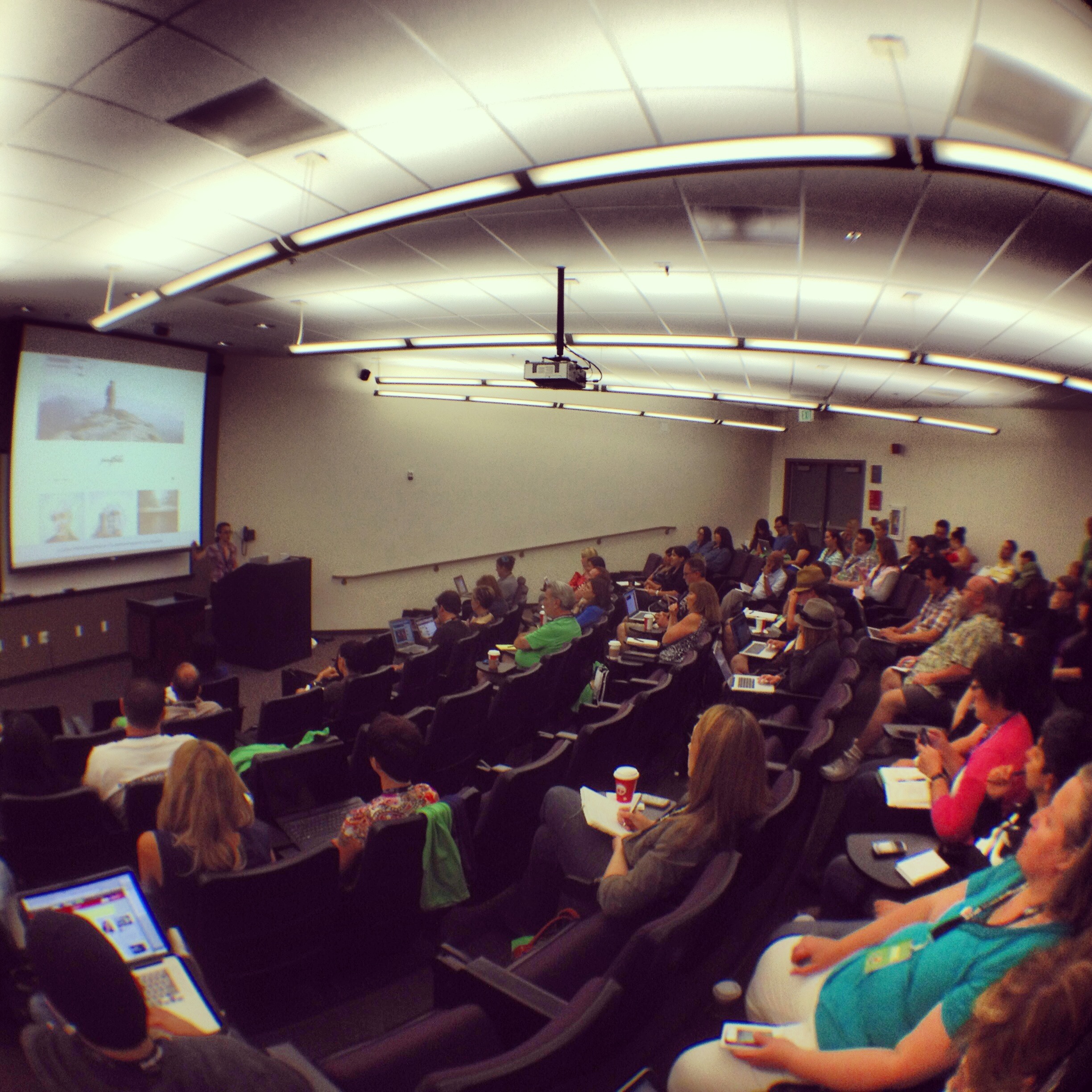
Saturday I spent the day with a couple hundred web developers, designers, publishers and blogging enthusiasts at an event called WordCamp OC. This the fourth annual WordCamp Orange County, and the eleventh WordCamp I’ve participated in.

WordPress OC

What is WordCamp?

I shared my plans for WordCamp with one of my hiking friends, Paul. He reasoned, “Oh, that’s why you’re so good at Words With Friends!” No, WordCamp isn’t about word play or word games. WordCamp is about WordPress — the open source content management system that powers about 22% of all new web sites on the Internet. As far as conferences go, these are local events organized by volunteers with the support of the WordPress community at large. Often people travel across state lines or even the country to attend. The speakers are practitioners who use WordPress, build sites using WordPress, and speak from practical experience. And unlike most professional conferences where registration often can cost hundreds or thousands of dollars, WordCamp OC was a mere $35, including two days of sessions, a t-shirt, coffee, lunch, snacks and beverages. That alone is worth much more, but the real value doesn’t show up on the conference schedule.

Why WordCamp?

wcoc2013_badge_im_heading_toThe challenge with WordCamp is serving the market. There’s a wide range of people interested in WordPress. Many are web developers, often specializing in building complex web applications using WordPress as a framework. Others are designers, trying to figure out how to create head-turning designs on a well-supported platform with a huge market. And still others own small businesses, or are aspiring entrepreneurs or bloggers looking to establish or just improve their own web presence.
I’ve been designing and developing web sites since 1995. I started building static web sites — as was the norm — but quickly moved to developing dynamic, database-driven sites. Such sites are easier to maintain and update, and quickly became the norm for most commercial sites. The challenge back in the 90’s was that the backend platform was the responsibility of the developer. Complex sites typically included a custom content management system on the backend. For me, that was built using Microsoft technologies: IIS, MS SQL Server databases and Active Server Pages (ASP).

In 2001, I began experimenting with emerging blogging platforms. At the time, Movable Type was at the forefront. I started this blog on it, and it served me well. in 2005, I made a decision to switch my development focus entirely from developing on ASP to PHP. Several of my sites were converted as well — a major task.

And in 2007, I began looking at PHP-based content management systems (CMS). I had done some development using Drupal, and was testing Joomla. But in August 2007, I made a trip to San Francisco for my first-ever WordCamp. What I saw and learned over that weekend convinced me that WordPress would become my development platform of choice. And I haven’t looked back.

The WordPress community is rich with resources — millions of smart people who willingly share their knowledge and own experience. And the WordCamp events around the world give them an opportunity to gather face-to-face for real interaction.  This interaction happens all the time, in online communities, forums, in Facebook groups, on Twitter, via podcasts and through local WordPress Meetup groups. But the annual WordCamp has become a bit like the grown-up version of summer camp. It’s a chance to reconnect with your friends and colleagues. There are equal doses of learning, sharing, fun and frivolity. It strengthens the bonds of the community. WordCamp keeps the community vibrant, dynamic and growing.

I love that we live in an age where virtual communication and collaboration is so easy to achieve. But it will never replace the value of sitting around the table sharing a taco with colleagues and talking about our world travels. And sometimes we talk about WordPress, too.

What do you find most valuable about the conferences you attend?

Leave a comment and let me know where you find value in face to face conferences.

And thanks to Brandon Dove, Jeffrey Zinn, the fantastic speakers, volunteers and attendees who all make WordCamp an event worth participating in.


Posted on Leave a comment

30 Days of Creativity: Day 1

National Trails Day

My first creation for the 30 Days of Creativity project was simple, but it was a busy day, what with WordCamp OC and the Mile…Mile and a Half premiere. I started with a photo that I took on our Bald Mountain hike at Sugarloaf Ridge State Park in Sonoma, applied some text reminding everyone that June 1st is National Trails Day, and softened it in Instagram. Done.

Posted on 3 Comments

30 Days of Creativity

My friend Kolby30daysofcreativity (aka The Hike Guy) — trail journalist extraordinaire and all-around great guy — posted a note on Facebook about something called 30 Days of Creativity. It’s an annual event that occurs during the 30 days of June, and it’s intended to give creators a little extra motivation to make something. How? By committing to creating something — anything — on each of the 30 days of June. And just maybe, creating a habit of creating in the process.

Signing up is as easy as sending a tweet to @createstuff saying “I pledge to create something everyday for 30 days in a row.” You can also use the #30doc hashtag on your creations. Tweet them out, or pin them to the Pinterest board.

I can do anything for thirty days, so I’m in.

Are you a creator?  Share a note in the comments below with a link so we can connect!

Posted on 3 Comments

Customer Service, Social Networks and Fixing What’s Broken

Break Free

It’s easy to pick on the cable company. Most of them are easy targets for derision. The services are overpriced and the customer service often ends up the butt of jokes.

I’ve had my own ups-and-downs with my current cable company — Time Warner Cable. Most recently, this centered around a single episode of a single show: Homeland, Season 2, Episode 11.

The Backstory

I have been catching up on the Homeland Season 2 replay on Showtime, recording episodes using a Season Pass on TiVo. For whatever reason, episode eleven eluded the long arms of my HDR while we were away in Sonoma. My challenge? How to legally get the missing episode.

The first option would normally be to use the on demand functionality provided through TWC. Unfortunately, because I use a TiVo box with a cable card, the on demand functionality is not available.

HBO has a great app for the iPad that lets you view pretty much any episode of any of their series, going back for years. You can even view it via AirPlay and your Apple TV. Too bad Homeland is on Showtime. Fortunately, Showtime also has an iPad app with similar on demand playback. Unfortunately it only works with certain cable providers — and TWC is not one of them.

Fortunately, TWC has it’s own iPad app called TWC TV which provides on demand functionality, including Showtime series (if you’re a subscriber, which I am). This was promising. I searched for Homeland, found Season 2, clicked on Episode 11, and… FAIL! It would not play. Check episode 10. That works. Episode 12? That also works. Episode 11 is the only episode that won’t play.

Calling TWC customer service led to the typical, unfulfilling canned responses. “Are you able to play other episodes?” Yes. “Have you tried the on-demand feature on your TV” No, I cannot because I use a cable card and a TiVo, not a cable box. “Have you tried reinstalling the TWC TV app?” Yes, with the same results. Finally they were able to confirm with another tech who had an iPad that they, too, could not play Homeland, Season 2, Episode 11. The answer? They would have to re-load the episode on their on-demand server, and to keep trying in a few days. I would not get any notification when (or if) it were resolved.

Two weeks later. Episode 11 will not play. In fact, it’s disappeared from the episode list entirely.

homeland-error

This time, a tweet was in order.

Next, TWC is calling me, to help sort out the problem Again, we repeat the dance. “Are you able to play other episodes?” Finally, I get them to realize (again) that the problem is with that particular episode on their server. And again, the solution? Wait a few days and try again.

Frustrated, I finally decide to bring the cable box out of the closet, dust it off and hook it up. Had to dig out a couple coaxial cables and a splitter, and add to the tangle of cables. Finally, it’s all hooked up. Fire up the cable box, press the “on demand” button and… FAIL. Ugh.

One more phone call to TWC support, and they send a signal to the box. Finally it’s working  (though still not on the TWC TV app).

The Lesson Learned

There’s a few lessons in this experience. First, it was interesting to note that TWC is actively monitoring Twitter. It’s a smart move for them, even though they weren’t able to actually solve the problem.

 …Remember, these days, when you’re talking to one person, you’re talking to a thousand. -Zoe Barnes, House of Cards

From a consumer perspective, I got more intelligent response from a tweet than from a phone call to their toll-free customer service line. Of course I made a point of mentioning the TWC twitter account, but it got action–and more intelligent action–much faster. Social networks empower consumers.

Which leads to the more important lesson. Having responsive customer service is only meaningful if you can actually fix the problem. In this case, TWC failed. Granted, it may be fixed eventually, but they weren’t equipped to resolve the issue even after several weeks. It’s a problem of bureaucracy, and a symptom of broken processes in the organization. The real problem for TWC in this case is not one of sloppy customer service, but an inability to fix what’s broken with their own internal processes.

A Broader Application

All of this begs the question: What’s broken in your company? In your organization? In your life or relationships? If the experience sucks, something must change. Fixing the problem involves change. Embrace the change. 

Insanity: doing the same thing over and over again and expecting different results. – Albert Einstein

Postscript

For what it’s worth, I was finally able to watch Homeland, Season 2, Episode 11 last night. And yes, it was worth it.

Photo credit: Nickwheeleroz on Flickr

Posted on Leave a comment

PechaKucha Night Fullerton

pechakucha

Have you been to a PechaKucha Night? These lively events feature short, six-minute presentations with precisely 20 slides — each slide displayed for 20 seconds–20×20. It’s been adapted by other groups such as Ignite (who uses a 20×15 format). One of the wonderful things about these events are the energy and fun. The 20×20 cadence requires presenters to be concise and really get to the salient points. And conversely, if a speaker sucks, the suffering only lasts for six minutes.

I’ll be presenting tonight at the first quarterly PechaKucha Night Fullerton. Interested in joining a group of smart, artistic, creative and thoughtful folks? Get all the details.

Posted on 2 Comments

Why I Ran the LA Marathon

Jeff at the LA Marathon finish _Snapseed

On St. Patrick’s Day, March 17th, 2013, I completed the LA Marathon–my second marathon, and the first in over five years. Though my official time was a modest 5:28:44, my previous time was just over 6 hours. Running a marathon requires a huge commitment of time and energy — two resources that are finite and precious. The training can be tedious and painful, and the race itself strained my 50-year-old body.

So why did I run the LA Marathon? Let me begin with a little background.

I started running back in 1976. I was in ninth grade, and I joined the cross-country team at Center Grove High School in Greenwood, Indiana. When the cross-country season ended in November, we’d start the “Roadrunners Club” to keep up our endurance for the spring track season. We’d tally our miles accumulated through the winter, and the coach awarded us with a red t-shirt with the cartoon Roadrunner on the front, and our mileage ironed-on the back. We didn’t call it gamification back then, but that was the general idea.

I continued running when my family moved to Irvine. I didn’t break any records, except occasionally my own. I wasn’t the fastest, and not the slowest. But I showed up, and I ran, even though I never really considered myself a runner. I’ve heard it said that “a jogger runs, but a runner jogs.” Clearly, I was a jogger.

I’ve run on-and-off through the years, though not consistently. But in 2007, I decided to run my first marathon. I trained with Team in Training, raising over $2000 for the Leukemia and Lymphoma Society. A month before the marathon, I came home from a one week vacation with a bug that turned into walking pneumonia. I was in bed for one solid week, and missed my longest training run. But the training still paid off, and I completed the San Diego Rock-and-Roll Marathon. As in high school, I wasn’t the fastest (not by a long shot) but I wasn’t the slowest, either.

After that first marathon, I turned my interest to other physical activities, first mountain biking, and then (after breaking my wrist on the San Juan trail) hiking. I set my sights on a new goal: through-hiking the John Muir Trail, 30 years from when I first hiked it at 18. This epic backpacking trip required months of planning, training and preparation. And in the process, SoCal Hiker was born. I focused all available time and energy on training for hiking long miles on the trail at high elevations, carrying everything I need on my back. There is a time for everything, and this was not the time for running.

Last year I decided it was the time for running once again, and I began training for the La Jolla Half Marathon. This is a beautiful course, running along the coast from Del Mar to La Jolla Cove. I followed the Jeff Galloway run-walk method, and finished with a time that I was happy with (2:20, and my personal best). I thought about maybe running a marathon again, someday. But not until October 2012 did I commit to running this year’s LA Marathon. I blame my friend Jeff Turner for lighting the fire under me.

This time, I followed Jeff Gaudette’s beginner marathon training plan through RunKeeper… mostly. I started training in November, and logged 369.7 miles and over 80 hours of running. A few snafus kept me from completing all the runs I had scheduled, including travel with 18 days in Mumbai and a brief bout with the flu. But I kept plugging away, and on March 17th, I was proudly among the 25,000 runners wreaking havoc with LA street traffic. I finished in 5 hours, 28 minutes — improving my 2007 marathon time by more than 30 minutes.

Why I Ran the LA Marathon

As you see, it’s been a long journey to get there, with a lot of sweat, blood and probably a few proverbial tears as well. Was it worth it? Why did I subject my fifty-year-old body to such a demanding task? What’s the ROI?

I ran this marathon for LA. My wife and I moved to Los Angeles last year, and are loving it. This marathon was my tribute to a wonderful city, and the route itself takes you on a grand tour of that city– from Dodger Stadium to Chinatown, through the soaring skyscrapers of downtown LA and the gleaming Walt Disney Concert Hall, through the heart of Hollywood, past the Chinese Theater, the Walk of Stars; down the Sunset Strip, Rodeo Drive, and stretching out to the beautiful bluff overlooking the Pacific Ocean in Santa Monica. It’s a terrific route, and the crowds lining the streets, cheering, passing out orange slices or water, and sharing high-fives made it even better.

I ran this marathon for me. Because I still can. Because I have the persistence to stick to the training, and the determination to reach the finish line. Because it makes me stronger.

Most of all, I ran this marathon for the ones I love. I ran for my wife, who inspires me to do more, and cheers me on. I ran for my children and my grand-children, to inspire them as well. To demonstrate that my “old man powers” (thanks, Dan) can do pretty amazing things. And to show them that if I can do it, they can do amazing things, too! 

There are life lessons in training for and running a marathon. Like so many things in life that we aspire to, it requires planning, hard work and preparation. Obstacles will arise, and you may have to adjust and adapt. Set big, bold goals. Do the hard work, and cross that finish line. That lesson is worth retelling– to myself, my family and my friends. And that is why I ran the LA Marathon.

What is your marathon? Are you ready?