
I can see the headline now: “Time travel is now a reality,” says leading WordPress scientist.
One of the features that many people either 1. never learned about or 2. forget that it is there is the ability to schedule posts for publication at a specific date and time.
 By default, when you initially publish a post or page, or save a draft, WordPress will grab the current date and time and use this as the publication date. You can override this to either back-date a post or post date for future publishing. This is great for scheduling posts when you know you want to announce something when you will be offline, or when you need to embargo information until a particular time.
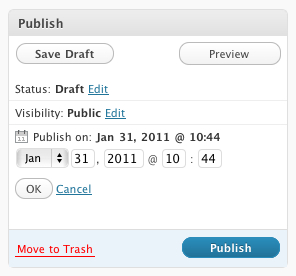
To change the publish date, simply click the edit link in the Publish block and you’ll gave options to set the month, day, year and time of the post. Yes, time travel really is possible.
Note that if you select a date in the future, the Publish button smartly changes to a Schedule button. Pretty clever.
If you are going for consistency over time, another great tool is the Editorial Calendar plugin available in the WordPress plugin repository. This adds a new Calendar link in your Posts menu, which then displays a scrollable calendar showing all your posts plotted over it. From here you can add new posts, schedule posts for future publication and get a clear picture of when articles need to be ready. Here’s a screencast from the plugin author Zack Grossbart that shows all the bells and whistles.

I’m using this more and more as I add rigor to my publishing schedule as part of my project for 365 posts in 365 days. I’m able to slot in topics that I know I want to cover, and do it on a timeline that makes sense. I can collect my thoughts in a draft mode, then polish up the post before publication. If I finish early, I just schedule the post to go live on the selected date.
What tips and techniques do you use to manage your editorial calendar?




 This year


 Today is a very special day. My sweetheart is celebrating The Big Five-Oh. She likes to tease me saying she’s been waiting for me for 50 years, but I think she has that backwards.
 Knowledge management (KM) can help transform an organization as people begin to connect, leveraging the best knowledge and expertise to improve work processes and deliverables. Last week, I discussed