Posted on 5 Comments

Social Media Explained (with Donuts)

Social media takes on many forms, and is ever-evolving. This infographic explains the common perceptions behind some of the popular social media applications, illustrated with a use case that we can all relate to: donuts.

Social media explained with donuts

[jpshare]

You can quibble over the inclusion or exclusion of particular social media applications, but the intent remains much the same.

What exactly does this tasty infographic imply? Each social media application serves a unique purpose.

Twitter allows people to share brief updates and popularized the concept of #hashtags that has spread to Instagram and is now spreading to Facebook and Flickr. Of course, the real value for me is to connect with people around a subject (usually based on a hashtag), collecting and sharing ideas. Personally, this has been extremely useful to me in keeping up with the latest on #KM (knowledge management) and #hiking (my weekend passion).

#Hashtag Trivia: Chris Messina was the first to suggest the use of the hashtag in Twitter, back on August 23, 2007.

Facebook makes it really easy for people to share what they like, and in the process, collects valuable demographic information about you that they can sell to marketers. Mark Zuckerberg has promoted the concept of frictionless sharing, making it even easier for them to know what makes you tick. The benefits to you? The social graph search. This also benefits marketers. With over one billion users, is Facebook too big to fail?

Location-awareness application Foursquare gives you the opportunity to check-in at restaurants, stores, and businesses. The initial idea was that your friends in the area might see that you’re at a certain bar, and that would prompt them to join you. That never really took off (at least for me… my friends are apparently privacy-shy Luddites) but it has evolved in to a useful app for finding tips, recommending places near you, and even occasionally offering discounts and special offers for checking in. Facebook and Google have both been trying to get in on location-awareness for local marketing, but no clear winner has emerged.

Instagram isn’t the only smartphone photo-sharing application out there, but it’s one of the most popular. Instagram’s major innovation wasn’t the groovy, retro-photo filters that people either love or hate, but that it launched as a mobile-only social network. When they launched, you could only view or interact via your mobile phone. That’s since changed, but they recognized that a significant shift had occurred — we use mobile devices to connect to the Internet more than traditional computers.

YouTube has given everyone a chance to become a video star, and established itself as a black hole that bends time like nothing else. I’ve only dabbled with YouTube publishing, but some people have embraced the social network capabilities, using them to connect with others in new ways. And almost everyone I know ends up viewing a few videos on YouTube at some point during their week. For higher quality content (but lower views) check out Vimeo.

While most of the social media tools listed are primarily for personal use (and yes, I know there are businesses using all of them), LinkedIn is squarely focused on professional networking. Connecting with colleagues and clients takes precedence over grumpy cat photos and selfies. Although some people find LinkedIn boring, the focus on business is what sets it apart.

Pinterest approached the idea of sharing content from a fresh angle, letting people “pin” their favorite things to a board. With a focus on great images, it really took off, especially with women. Dozens of copycats have tried to replicate their success, but none have come close.

Many people haven’t heard of Last.fm, but this venerable social network has been capturing music listening habits for many years. Last.fm lets you autoscrobble the songs you play and–over time–knows what artists, genres and songs you like the most. Based on that, it can recommend new artists that it thinks you’ll enjoy, and can connect you with other people who share your taste in music. I’ve setup Last.fm to scrobble my plays on iTunes and Spotify, and occasionally listen to the Last.fm app on my Xbox, streaming music through my home theater system.

The punchline in the infographic is Google+. Of course, many, many more people use Google+ than just the folks employed there, but from the people I know, they are the early adopters. Google likes to tout high adoption numbers, but their figures are murky; clouded by the inclusion of users of other Google apps like Gmail. How many people really use Google+? We may never know. But they have a lot of potential users.

The Business Case for Social Media

Most people look at these social networks as primarily targeted at consumers, using them for the personal benefit. But that doesn’t mean the companies don’t have a business focus. And while all of these products are free for you to use (although some offer premium versions), you should remember this advice:

If you are not paying for it, you’re not the customer; you’re the product being sold. – blue_beetle

Advertisers and marketers love the rich demographic data available as a result of our living out loud through social media. This helps them deliver highly targeted advertising that you are (theoretically) more inclined to find useful. And it gives advertisers the tools to hyper-refine the targeting of their messages. Instead of merely targeting camera enthusiasts they can target female Canon DSLR enthusiasts in the Los Angeles area. Hyper-targeting.

And though they were the punchline of my infographic,  Google stands to gain handsomely from all of this data. They reign supreme as King of Search. And as their other suite of applications grows, they gain further opportunities to aggregate, correlate, and repackage you to advertisers.

So WIIFM?

What’s in it for me? Why do I use these various social networks? I use them to make new connections, and strengthen existing ones. I also use them for my personal data collection, as I grapple with the concepts behind the quantified self and how to apply that data for positive change.

What about you? What do you get out of social media? What do you love (or hate) about these tools?

Posted on Leave a comment

The New Linkedin Profile: Love It or Hate It?

Back in October 2012, LinkedIn announced a redesigned profile page. They’ve been slowly rolling it out to users, and finally updated mine this week.

What’s new in the new profile design?

For starters, the interface has been refreshed, with sections clearly noted. And it features inline editing, meaning you can make changes right from your profile without switching to a separate “edit” view. See something that needs updating? You can change it right there.

Your recent activity is highlighted near the top of your profile. While this is useful to see if someone is actively interacting on LinkedIn, it will make me think twice before posting a link or liking an update.

There is a new visual representation of your network–a sort of simplified InMaps view–and you as you hover over other LinkedIn members, you’ll see a card pop-up with additional info about that person. Their goal is to stimulate interaction and engagement with your network.

What’s no longer there? 

There are some features, particularly third-party apps, that don’t show up anymore. I only used a couple of these; the TripIt widget and the Reading List. Not really critical.

Overall, I like the new design. It’s not going to rock your world, but it’s a nice update to an otherwise stodgy user interface. But what do you think? Let me know in the comments, and feel free to connect with me on LinkedIn.

jeff-hester-on-linkedin

Posted on 1 Comment

Election Day, the Wisdom of Crowds, and the Enterprise

In The Wisdom of Crowds, author James Surowiecki suggests that leveraging the collective can often yield better results that asking any single expert. On election day, there are plenty of examples of crowd wisdom and prediction markets to draw from.

In business, we’re often focused on efficiency innovations — incremental improvements in efficiency that save time, money, or preferably both. So can crowdsourcing be used to automated processes effectively in the enterprise?

The answer? It depends on the question. 

If the problem can be represented by a simply solution such as single number (42?), or deals primarily with optimization, then crowdsourcing can make a lot of sense. In the presidential election, leveraging the crowd to predict the winner fits the first dimension perfectly. There can be only one winner: either Romney or Obama.

If the problem, on the other hand, is complex, requiring wisdom and expertise, the crowd will be of little help. If you need to engineer a fuel system for a new airplane, the crowd may actually do more harm than good. While “asking the audience” may work statistically for “Who Wants to Be a Millionaire,” remember that those questions also present multiple choice answers. And do you want to be on the maiden voyage of a new aircraft designed by the crowd?

Part of the problem–and therefore, the solution–comes from defining what we mean by crowdsourcing. Is it asking for an answer, even from the uninformed? If we’re talking elections, yes. If we’re talking jet propulsion, absolutely not.

Can we apply the wisdom of crowds in the enterprise? Certainly, but we must do so thoughtfully. Polling the crowd, whether that be inside our outside the firewall, can help inform decision-making. The crowd can either confirm or challenge our conclusions, but it does not replace the need for critical thought. And when safety is on the line, we have to be vigilant that we don’t allow a confirmation by the crowd to lull us into happily accepting our hopeful answer as the correct one.

After all, the crowd can be wrong. 

What do you think? How and when would you apply the wisdom of crowds inside your organization?


Posted on 4 Comments

November, Movember, Knowvember: Day 1

November is an extremely busy month for me, for a variety of reasons. Here are just two:

Knowvember is an annual celebration at work with employee recognition through the KM Pacesetter Awards, the annual KM Success Story contest, and coordinating workshops with KM Champions in offices on six continents. This week I wrapped up four “train-the-trainer” sessions and over the next four weeks will be presenting this year’s message at a number of offices (including Mumbai). This program is in it’s 11th year, and it while you might think it would get easier, the reality is that you are constantly raising the bar and expecting something more… something innovative… something new. This year, that’s involved a lot of work on recorded screencasts. It’s the closest thing to being in two (or twenty) places at once.

Yikes! No beard!

Movember, on the other hand, is a lighthearted way to raise awareness for some serious men’s health issues. This annual awareness campaign involves men shaving their faces completely clean — no beard or mustache — and then proceeding to grow and groom a mustache — and only a mustache — over the remainder of the month.

For those men who normally wear their face clean-shaven, Movember is a bit of a lark. For me, it means shaving off the mustache and goatee that my wife has never seen me without. Needless to say, it’s a different look.

All this silliness serves a more serious purpose, and you can join in. Show your support for men’s health by spreading the word. And consider making a contribution. The funds go to several groups that raise awareness and provide research on testicular and prostate cancers.

Men, be sure you’ve scheduled an annual physical. Ladies, show your love and nudge them to get checked.


Posted on 2 Comments

The Power of Knowledge Discovery in Moscow

Two weeks ago I spoke in Moscow at Knowledge Management for the Oil and Gas Sector: Project Optimization and Business Efficiency. This international conference was attended by a number of clients–including BP, CononcoPhillips, Chevron and Lukoil–and we shared how we were using knowledge management to address the business needs facing our respective companies.

Moscow is the largest city in Europe, and if it weren’t for the famously onion-domed churches dotting the city, it would look much like any major metropolis, right down to the Starbucks and KFC. I was surprised to discover the dramatic changes the Muscovites have seen during my lifetime.

Being an informed traveler on my first visit to Moscow, I used GlobeSmart to learn about business etiquette and travel tips. While the advice was sound, it was also very generic. I very nearly forgot the most basic advise of all–leveraging our own KM system. A simple search for the term “Moscow” turned up a guide for visitors created by our Moscow office, complete with the inside information on getting from the airport to the hotel, restaurant recommendations and local contacts. Sometimes knowing what you’re looking for can cause you to miss the valuable knowledge you don’t yet know exists.

During my talk I shared this story to illustrate the power and promise of knowledge management to expose knowledge that we don’t know exists. Finding what we know exists is relatively easy; but discovering knowledge we don’t yet know of–knowledge that can shape our decision process and help us reach better solutions–that is real power.

Special thanks to my colleague Tara for reminding me of the power of knowledge discovery.

Posted on 3 Comments

TED 2012: Leap Day Highlights

Leap year comes once every four years. But what to do with an extra 24 hours?

This year I had the opportunity to spend Lead Day feeding my mind at a simulcast of the 2012 TED conference. I am a big fan of TED. The conference was started in 1984 by my first year architecture professor who envisioned a gathering of great minds discussing big ideas in technology, education and design. Chris Anderson took the reins, expanded the scope and now TED is nearly omnipresent. The TED Talks videos can be found all over, and TEDx events leverage the popular format on a local scale.

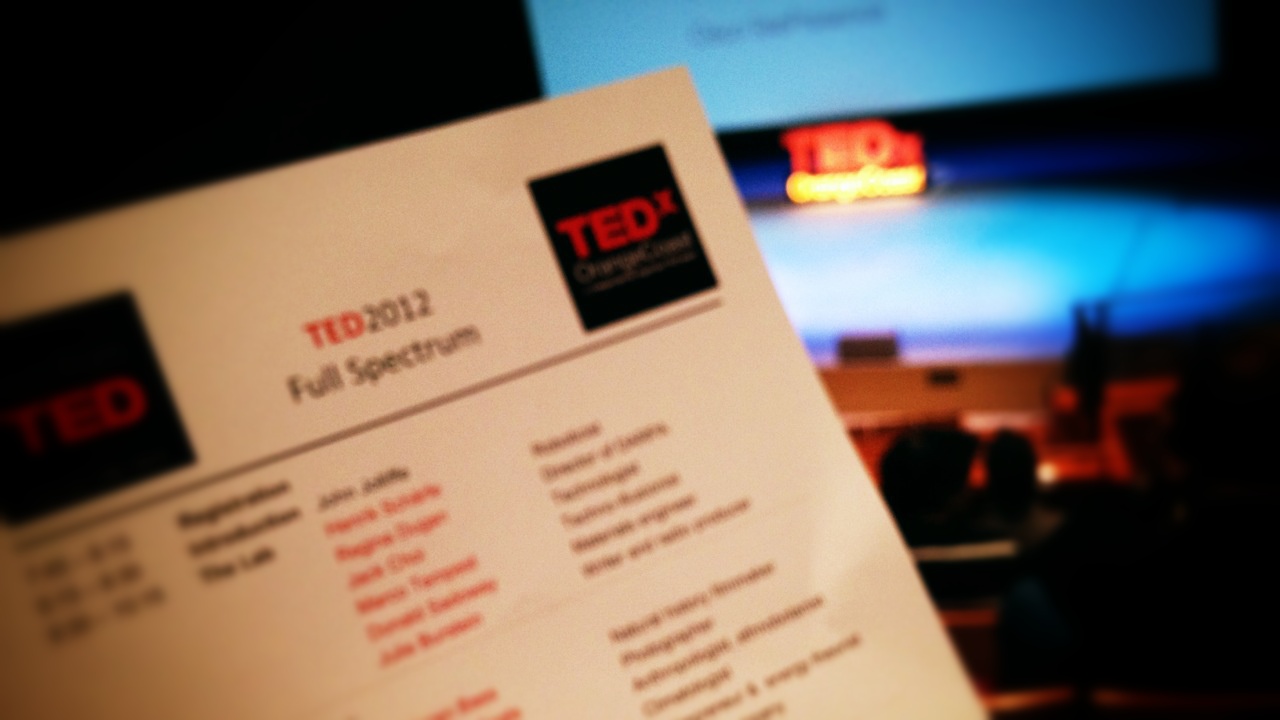
Last year I attended the local TEDxOrangeCoast at Segerstrom Hall — a remarkable day in itself. And this year, the big TED conference in Long Beach (a 3-day event) opened their virtual doors to TEDx attendees for a simulcast of the Day Two talks. In Orange County, we met at the beautiful Soka University performing arts center.

TED speakers get roughly 18 minutes on stage to share their stories–which are varied. Their titles range from techno-illusionist to ethnobiologist; from secret keeper to code activist. Some are selected for their ability to move and inspire. Others for their research (and certainly NOT their speaking skills).  And some are just plain entertaining. The net result? Brain food for fertile minds. Leap Day inspiration!

Eventually you’ll be able to see these talks online. Until then, I wanted to share highlights from two of those speakers, as well as observations from the backchannel.

Reid Hoffman, Social entrepreneur

Reid Hoffman is probably best known as co-founder of LinkedIn, the popular professional network. He’s also an investor, and entrepreneur and most recently, an author.

One thing Reid is not: a great speaker. He referred to a written script during much of the talk, making for a dry presentation of an important topic.

The delivery was lacking, but the message — while not really new — was worth hearing again.

We used to “climb the corporate ladder.” According to that model, when you graduated from college, you took an entry-level position. You worked hard and got promoted. With each step up the ladder, you gained responsibility, power and money.

That model no longer works. Today, the paradigm is not the ladder, but the network. We need to think like entrepreneurs, and treat our careers like a business. To be clear, understanding and leveraging your network is not the same as “networking.” It isn’t exchanging business cards and calling prospects. It is looking at your actual network of friends, colleagues and cohorts. Your network includes the people that you can help, and who can help you solve problems, move mountains, and get things done.

Not surprisingly, Dunbar’s Number came up. Reid suggested that 150 is not really a network limit, but memory limitation. Tools (such as LinkedIn, of course) can extend our memory, allowing us to build bigger networks.

What piqued my interest was Reid’s thoughts on how your network is a reflection of who you are. This isn’t really a new idea. Even as teenagers, most of our parents wanted to make sure we didn’t hang out with the “wrong” crowd. But in today’s world of connected-ness, many people see a connection as a prospective customer — and the more the merrier. In reality, it’s less about the numbers (unless you’re only about the numbers), and more about who you want to be. Whether we lead or follow, the crowds we run in reflect who we are.

Lior Zoref, Crowdsourcing advocate

I loved this colorful kid from Tel Aviv. He opened with a video recorded a year ago, where he shared his dream of speaking at TED. His best friend mocked him, but Lior promised that when (not if) he finally did speak at TED, he would play this video to remind him of his words.

Lior Zoref is not a household name. He is not particularly famous. But he is an evangelist for crowdsourcing, and his fervor for the wisdom of crowds was his ticket to the main stage at TED. Lior presented what he claims was the first-ever “crowdsourced TED talk.”  He tapped into his network of friends on Facebook and Twitter to help him create his talk — a mix of crowdsourcing stories from around the globe, liberal doses of humor and an extremely fun, live crowdsourcing experiment.

Photo: James Duncan Davidson

Early in his talk, he brings out a live ox onto the stage. The audience is asked to pull out their smartphones, visit a special web site and enter their guess at the animal’s weight. He continues his talk, and towards the end…

Over 500 people submitted their guesstimate, with responses ranging from 385 pounds to over 8000 pounds. The average of the crowd came in at 1792 pounds. The actual weight of the ox? 1795 pounds… just three pounds more. An amusing, live illustration of the wisdom of crowds.

Can crowdsourcing really make us smarter? Perhaps, but not all kinds of questions are well-suited to this kind of “guess-the-number-of-jelly-beans-in-the-jar” kind of problem-solving. Would you want to design a bridge the same way?

No matter what you think of crowdsourcing, you had to admire Lior’s enthusiasm and his ability to dream big.

Back in the Real World…

There are a few people that I repeatedly bump into online and offline, and at TED I had the opportunity to break bread with two of them over lunch. Chris Fleury and Emily Crume. We are perpetually crossing paths at various local events such as SMMOC, and over and over online. It was great to get a chance to know them better. The face-to-face interactions proved again to be as valuable — or more valuable — than the simulcast speakers of TED.

There was much more at TED than will fit in 1000 words. Here are some additional highlights:

This post was percolated with the help of the ingenius Dashter.