

Leap year comes once every four years. But what to do with an extra 24 hours?
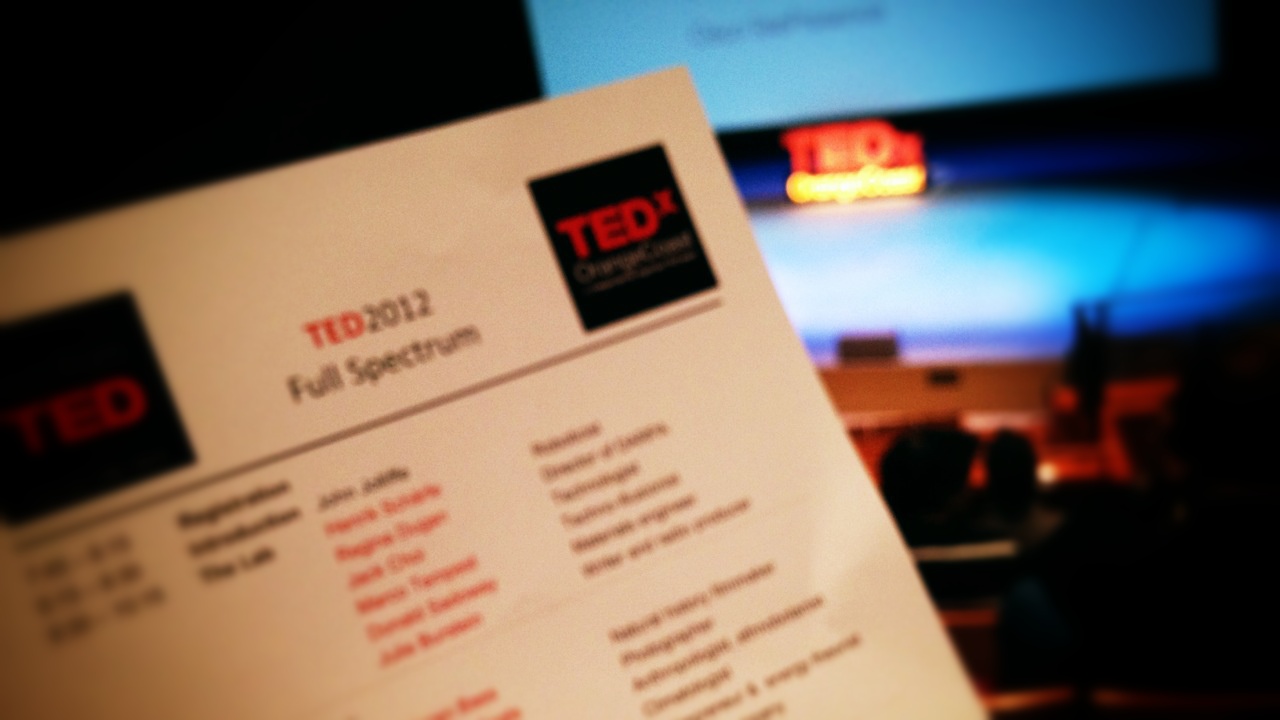
This year I had the opportunity to spend Lead Day feeding my mind at a simulcast of the 2012 TED conference. I am a big fan of TED. The conference was started in 1984 by my first year architecture professor who envisioned a gathering of great minds discussing big ideas in technology, education and design. Chris Anderson took the reins, expanded the scope and now TED is nearly omnipresent. The TED Talks videos can be found all over, and TEDx events leverage the popular format on a local scale.
Last year I attended the local TEDxOrangeCoast at Segerstrom Hall — a remarkable day in itself. And this year, the big TED conference in Long Beach (a 3-day event) opened their virtual doors to TEDx attendees for a simulcast of the Day Two talks. In Orange County, we met at the beautiful Soka University performing arts center.
TED speakers get roughly 18 minutes on stage to share their stories–which are varied. Their titles range from techno-illusionist to ethnobiologist; from secret keeper to code activist. Some are selected for their ability to move and inspire. Others for their research (and certainly NOT their speaking skills). And some are just plain entertaining. The net result? Brain food for fertile minds. Leap Day inspiration!
Eventually you’ll be able to see these talks online. Until then, I wanted to share highlights from two of those speakers, as well as observations from the backchannel.
Reid Hoffman, Social entrepreneur
 Reid Hoffman is probably best known as co-founder of LinkedIn, the popular professional network. He’s also an investor, and entrepreneur and most recently, an author.
One thing Reid is not: a great speaker. He referred to a written script during much of the talk, making for a dry presentation of an important topic.
The delivery was lacking, but the message — while not really new — was worth hearing again.
Adam Ostrow: LinkedIn founder Reid Hoffman: “Be the entrepreneur of your own life” #TED bit.ly/z4QF1N #SocialMedia #SM #jo
— Ahmed Akour (@akour_) February 29, 2012
We used to “climb the corporate ladder.” According to that model, when you graduated from college, you took an entry-level position. You worked hard and got promoted. With each step up the ladder, you gained responsibility, power and money.
That model no longer works. Today, the paradigm is not the ladder, but the network. We need to think like entrepreneurs, and treat our careers like a business. To be clear, understanding and leveraging your network is not the same as “networking.” It isn’t exchanging business cards and calling prospects. It is looking at your actual network of friends, colleagues and cohorts. Your network includes the people that you can help, and who can help you solve problems, move mountains, and get things done.
Not surprisingly, Dunbar’s Number came up. Reid suggested that 150 is not really a network limit, but memory limitation. Tools (such as LinkedIn, of course) can extend our memory, allowing us to build bigger networks.
@TEDNews: “The network of you is not just what you broadcast about yourself, but what others say about you.” Reid Hoffman #TED”
— Jonathan Hill (@JHHill) February 29, 2012
What piqued my interest was Reid’s thoughts on how your network is a reflection of who you are. This isn’t really a new idea. Even as teenagers, most of our parents wanted to make sure we didn’t hang out with the “wrong” crowd. But in today’s world of connected-ness, many people see a connection as a prospective customer — and the more the merrier. In reality, it’s less about the numbers (unless you’re only about the numbers), and more about who you want to be. Whether we lead or follow, the crowds we run in reflect who we are.
Lior Zoref, Crowdsourcing advocate
I loved this colorful kid from Tel Aviv. He opened with a video recorded a year ago, where he shared his dream of speaking at TED. His best friend mocked him, but Lior promised that when (not if) he finally did speak at TED, he would play this video to remind him of his words.
Lior Zoref is not a household name. He is not particularly famous. But he is an evangelist for crowdsourcing, and his fervor for the wisdom of crowds was his ticket to the main stage at TED. Lior presented what he claims was the first-ever “crowdsourced TED talk.” He tapped into his network of friends on Facebook and Twitter to help him create his talk — a mix of crowdsourcing stories from around the globe, liberal doses of humor and an extremely fun, live crowdsourcing experiment.

Early in his talk, he brings out a live ox onto the stage. The audience is asked to pull out their smartphones, visit a special web site and enter their guess at the animal’s weight. He continues his talk, and towards the end…
Zoref says crowd estimated ox’s weight at 1792 pounds; the actual weight is 1795 #TED
— Richard Galant (@richny) February 29, 2012
Over 500 people submitted their guesstimate, with responses ranging from 385 pounds to over 8000 pounds. The average of the crowd came in at 1792 pounds. The actual weight of the ox? 1795 pounds… just three pounds more. An amusing, live illustration of the wisdom of crowds.
Through crowd sourcing we can upgrade our brain. We are entering the age of mind sharing @liorz #TED
— Eythor Bender (@eythorbender) February 29, 2012
Can crowdsourcing really make us smarter? Perhaps, but not all kinds of questions are well-suited to this kind of “guess-the-number-of-jelly-beans-in-the-jar” kind of problem-solving. Would you want to design a bridge the same way?
Very true RT @TEDxOrangeCoast: “Dreams are what makes us what we are” – Lior Zoref #TED #TEDxLive
— ? Sven Johnston ? (@SvenJohnston) February 29, 2012
No matter what you think of crowdsourcing, you had to admire Lior’s enthusiasm and his ability to dream big.
Back in the Real World…
There are a few people that I repeatedly bump into online and offline, and at TED I had the opportunity to break bread with two of them over lunch. Chris Fleury and Emily Crume. We are perpetually crossing paths at various local events such as SMMOC, and over and over online. It was great to get a chance to know them better. The face-to-face interactions proved again to be as valuable — or more valuable — than the simulcast speakers of TED.
There was much more at TED than will fit in 1000 words. Here are some additional highlights:
- Possum Problems and Building a Better Government – Jennifer Pahlka
- Secrets Take Many Forms – A comical and sometimes touching talk by Frank Warren of Postsecret.com
- And then there was Reggie Watts – I really look forward to the TED Live video of this guy. Defines explanation.
This post was percolated with the help of the ingenius Dashter.

 Deborah Anne Gibbs – @
 Jenny Corsey, APR – @
 Matthew Gallizzi – @
 Digital LA – @
 Brandon Skaar – @
 Andrea Memenas – @
 Mitch Devine – @
 Kris Carter – @
 Ellen Henderson – @
 eperry – @
 Emily Crume – @
 Renée Barrett – @