Documentaries fascinate me, and Restrepo is gripping. The Oscar-nominated documentary chronicles the deployment of a platoon of U.S. soldiers in Afghanistan’s Korengal Valley. The movie focuses on a remote 15-man outpost, “Restrepo,” named after a platoon medic who was killed in action. It was considered one of the most dangerous postings in the U.S. military.
My son Joel recommended this film and I wasn’t disappointed. There is no commentary or narration. The soliders and their actions speak for themselves. It is a gritty look at the harsh reality of life in a war zone and the human side to this band of soliders.
Yesterday I turned on my Samsung Blueray player to tune into Pandora (which sounds amazing cranked through my A/V system). I can count on one hand the number of times I’ve used my Blueray player to watch a disc, but I’m constantly using the various web apps: Netflix, Hulu Plus, and especially Pandora.
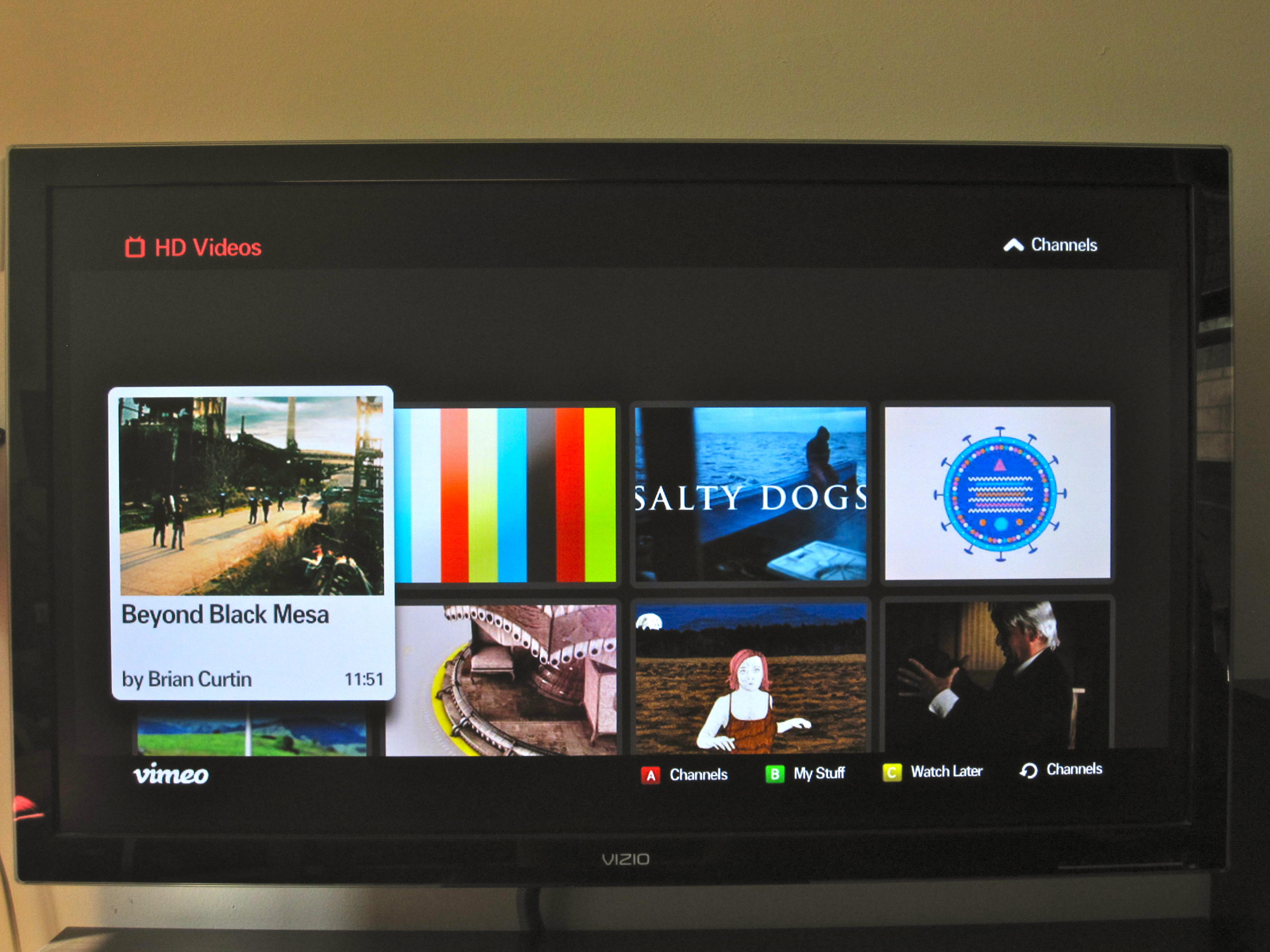
As the machine was powering up, I was notified of a system update. I always install updates, and this was not exception. While I love the device, I’ve got to ding Samsung on how they handle these updates. The process itself is smooth and trouble-free, but there’s no information about what the update includes! After some poking around I discovered that a new app to play Vimeo videos was available.
I’ve been using Vimeo for a while now to post videos for SoCal Hiker as well as sharing how-to and usability screencasts. The Vimeo interface is much more pleasant experience than the cluttered crap on YouTube, and Vimeo allows longer videos. As a result, the quality of content on Vimeo is generally much higher than YouTube.
Even so, I’ve never really done much browsing or watching Vimeo stuff on my computer. I typically only watch something when I run across it in the search for something else, like this video tutorial on creating a tilt-shift video. But I was curious to see what this new Vimeo app would do, so I installed it and fired it up.
It’s freaking amazing. Seriously.
The user interface is clean, hi-def and beautiful. I checked out some of my own videos first (vanity rules), then browsed a few of the curated channels. This is where I was completely, unequivocally sold.
Here’s how it works…
First you select a channel that looks interesting. There’s a number of really nice ones, but the HD channel is a great starting point.
Once you’ve selected the channel, you’ll see a scrolling list of the videos contained in that channel. You can simply hit play or browse through and find something that piques your interest.
William Gibson said, “The future is already here – it’s just not very evenly distributed.” This is the future of television programming, and it’s here now.
What is a browser? Ask the typical man (or woman) on the street that question and you’ll get some surprising answers.
Back in April 2009, some folks at Google did just that. They took a video camera to the streets of New York City to ask people “What is a browser?” Watch…
Clearly there is a disconnect between the tech-saavy and the rest of the world. So what does this mean? In my world, it means that those of us who create programs, web apps or devices need to do a much better job of simplifying, demystifying and educating. Certainly it means we use far too much “lingo” that is meaningless to most people. And it might not matter. After all, most people are getting around the Internet just fine even if they don’t know the proper answer to the question “What is a browser?” Should we care?
Well, I don’t we need to care that people use whatever new words we introduce (i.e. browser) but it does matter that people understand the basics. How do I get around and find the stuff that’s important to me? How do I avoid getting “tricked” by the bad guys on the web who want to steal my credit card number or my identity? And how do I make my computer, my mobile phone, and all my other connected devices serve me, and not the other way around?
Simplification
Keeping it simple has been one of the big reasons for the success of Apple. The iPod Shuffle doesn’t even have a screen. You just load it and play. The iPad is enjoying popularity with older people as well as toddlers precisely because it is so damn accessible. Not a lot of bells and whistles — it just works, and does it well.
In the world of the web, we don’t do so well. The web is littered with sites with dozens of choices all shouting for our attention. Steve Krug’s seminal book on web usability — Don’t Make Me Think (affiliate link) — addresses this problem head-on and largely on target. If you create websites or apps for any connected device, get his book and read it. If you’ve already got it, pull it out and read it again. The bottom line is that we creators and curators make things unnecessarily difficult for folks. Make it — and keep it — simple.
Communication
Some techies sneer at the newbies and their lack of what they consider basic web know-how. In their mind, the average Joe needs an education. Do they? Or do they just need someone to explain it to them? Both are close, but even better, why don’t we simply communicate better?
I’ve always believed strongly that communication is the responsibility of the communicator. In other words, if I want to communicate a message to you, it’s my job to do it in such a way that you comprehend and fully understand my message and it’s intent. We need to become better communicators.
Circling back to the video, Google thought a bit about this problem and figured there were some basics about how the Internet works that everyone should understand. They put together an online book titled Twenty Things I Learned About Browsing and the Web. The reading experience is very similar to using a Kindle or iPad, but just works in your browser. And the format of the book looks very much like a children’s book, which some people find charming and others condescending. But they get an “A” for effort.
As for me, I have my work cut out for me. My very field — knowledge management — draws blank stares from most people (who quickly regret having asked what I do). And many of the practitioners in the field have been raised on a steady diet of acronyms, obscure lingo and academic theory. It’s become part of their DNA, and they perpetuate this knowledge management geek-speak as a way to make themselves feel somehow a little smarter.
This reality is not unique to my field. The web makes it easy for almost anyone to become a creator, and we all have a long way to go. If we really want to reach people, we need to work on simplification and communication.
Recently an update to the WordPress iPhone/iPad app was released in the iTunes App Store. One of the interesting new features is the ability to record, upload, attach and play videos directly within the app.
I know several people who would love to streamline and simplify the process of posting video in near real time, so I thought I’d give it a try and see how it works.
Unfortunately, it did not work, repeatedly crashing when uploading the video. The WordPress iOS forums lit up with problems, and the dev team resolved to pump out yet another update.
And so version 2.6.1 was released on the iTunes App Store today. Updating the app wasn’t good enough… I got “Communication Error” when trying to view my posts. The forums suggested deleting and reinstalling the app.
So far, so good. Now let’s see if it can handle video!
David McCandless is a journalist who has developed a passion for making sense of data, beautifully. It’s a fascinating talk on finding patterns and truth through visualization, when data alone won’t suffice.
Last July, I spoke at the inaugural Ignite/LA on the use of virtual communities to enable strategic knowledge sharing across the enterprise. It took a while, but the video is now online.
The Ignite format uses 20 slides which auto-advance every 15 seconds making the presentation length a total of five minutes. The next Ignite/LA will be held on Monday, June 7th in Santa Monica. You can now register online.
Rolling Stone magazine made Kaki King the first women on the Guitar Gods list. Kaki has a unique, percussive style that can’t be fully appreciated without seeing it. Fortunately for us, her entire 15 minute performance at TED is now available. It’s worth watching.


 Documentaries fascinate me, and Restrepo is gripping. The Oscar-nominated documentary chronicles the deployment of a platoon of U.S. soldiers in Afghanistan’s Korengal Valley. The movie focuses on a remote 15-man outpost, “Restrepo,” named after a platoon medic who was killed in action. It was considered one of the most dangerous postings in the U.S. military.