Posted on 2 Comments

Petit à Petit Around Mont Blanc

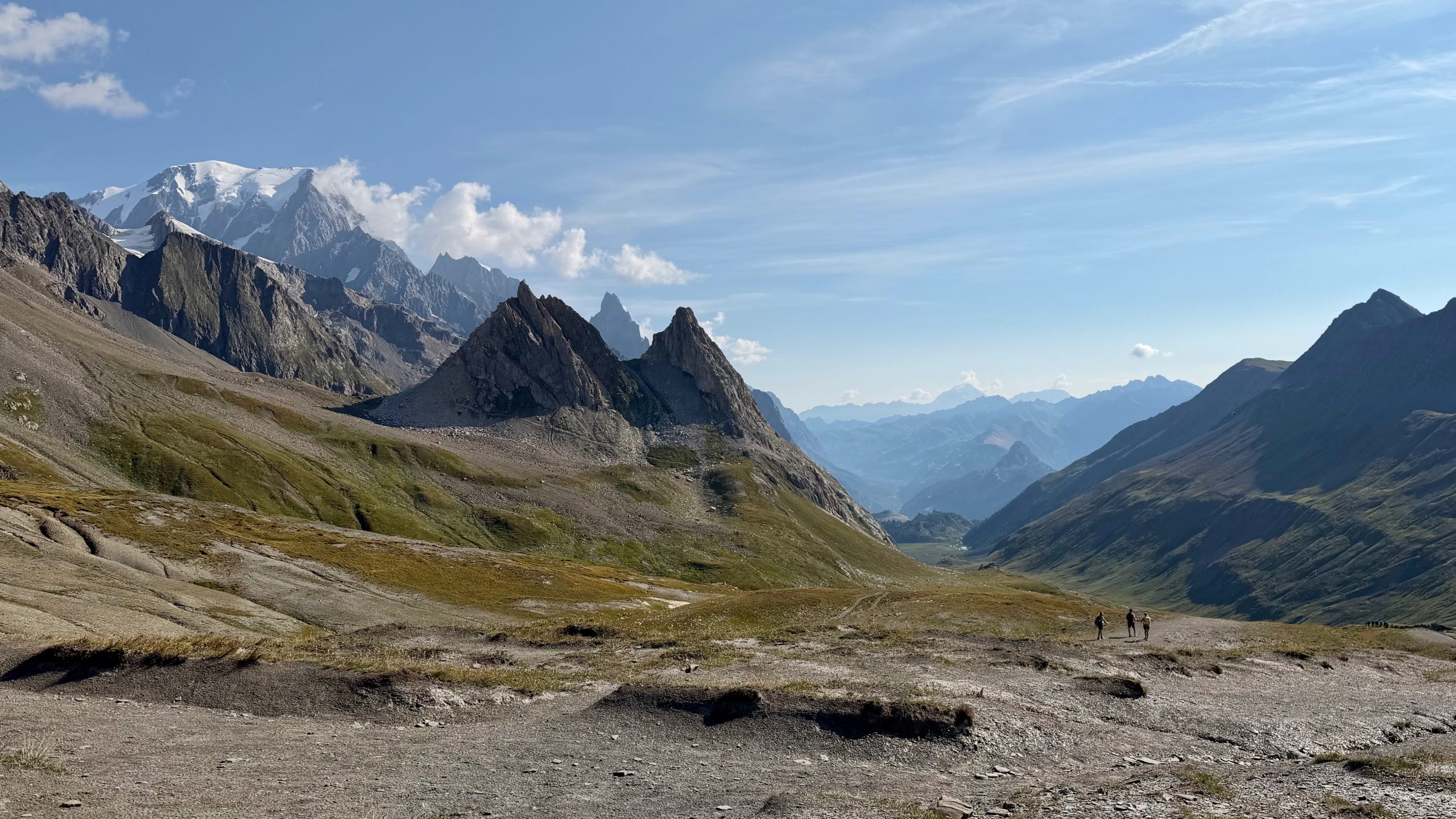
It was our third day on the Tour du Mont Blanc. We had hiked into Italy that morning, watching a herd of ibex lollygagging at Col de la Seigne, while Paul strummed his ukulele. Working our way toward Courmeyeur, we stopped at Rifugio Elizabeta for lunch — a cold Moretti and a hot bowl of pasta — all in the shadow of Mont Blanc, the highest mountain in Western Europe. And it struck me. This wasn’t a typical backpacking trip. This was more like glampacking in Spritz-erland.

Sausage and polenta for lunch as Rifugio Elizabeta in Italy

How did this all come about?

Originally, the Tour de Mont Blanc (TMB) wasn’t even on my radar for 2026. Moving to France in May, I figured we’d be busy enough finding an apartment, getting settled in and learning about Dijon. Most people hike the TMB from refuge to refuge, and reservations for 2026 opened in October 2025 and fill up well in advance. In my mind, 2027 would be the earliest option.

As it turned out, I saw a post in a TMB group on Facebook from a guy in California named Jon, who had two sets of two bookings for an 8-day itinerary that he couldn’t use and was looking to sell. It was an aggressive, 8-day itinerary in August. I just needed to find one person crazy enough to jump in and join me.

Paul and I have met, but never hiked. We are both from Southern California, where we share a number of backpacking friends in common (Jason, Ric, Derek, Adam, etc.). Though we had never hiked together, we did share one key thing in common. We had both moved to France. The Venn diagram that represented ‘SoCal backpacking friends’ and ‘currently living in France’ intersected at the two of us.

Hiking the TMB with Paul was a pleasure. I picked up new French phrases as we hiked. Pas mal (when taking in an amazing view, or sipping on a cold beer at a refuge). Petit à petit as I paced myself up another big climb over a col. His pace was about 10 years younger than mine, and oftentimes he’d reach the next refuge before me, with a cold beverage ready when I finally arrived. Pas mal, indeed!

And I’d be remiss if I didn’t give a shout out to Jen and Priscilla. They had picked up Jon’s other pair of reservations, and we crossed paths at most of the refuges. These young women brought positive energy to the TMB, and it was great to break bread together along the way.

Day 1 – Pleasure Mixed with Pain

The first day was tough. I realized that my stair master training at the gym might not have been adequate. I had climbed Mount Kilimanjaro back in January, but my fitness level had dropped since then. Assembling IKEA cabinets isn’t the same as repeatedly hiking Black Butte from the lower trailhead.

That first day, we ended up climbing 5,072 feet (1546 meters over 21 kilometers). Most people stop in or near Les Contamines on Day 1, but we continued on, climbing well off the TMB proper to the amazing Refuge des Prés. It was hot. The day was long. But we made it to the refuge, where a hot shower and meal (and calf compression sleeves) made everything a little better. Our biggest climb of the itinerary was finished. The remaining days would consist of climbs closer to 3000 feet (~914 meters).

Adaptation

In the past, I’ve strived to hike THE trail, whatever that trail might be. My wife Joan got a taste of this the first time we backpacked the Trans-Catalina Trail. Picking up our permit at the Conservancy office in Avalon, the helpful person told us of a “short cut” that would shave about six miles off the trail. Joan liked the sound of that, but I’d have none of it. I was determined to hike the entire trail.

That ideology still lives somewhere in the recesses of my psyche, though it’s mellowed with time. This trek on the TMB proved that adaptation was not a compromise, but an essential element to a successful trek.

Going in, we planned to take a bus from Courmayeur up the valley to Arnuova, where we would hike over the Grand Col and down to La Fouly. Not the purist route, but an adaptation that suited our schedule and turned Day Four from a true leg-killer into another enjoyable day on the trail.

The biggest adaptation? The food along each day. On Day Two we stopped at Fromage Beaufort for a tour of their cheese cellar and a sampling of their wares. Each day we had the opportunity to break for lunch at a different refuge, complete with a cold beer and a hot meal. I’ve never eaten so well on the trail, and it’s one adaptation that was easy to embrace.

Day 8 — the day we planned to finish the TMB — we made a game day call to skip straight to Chamonix. Thunderstorms were forecast for the morning and the afternoon, and the prospect of climbing the Grand Balcon with no views of Mont Blanc in potentially dangerous conditions didn’t sound nearly as attractive as a final night in a hotel, a hot shower and a burger somewhere in town. This was the most difficult adaptation for me, but I consoled myself with the thought that I could easily return and hike it another time. C’est la vie!

As it turns out, I’ll be returning to Chamonix next week to hike the Grand Balcon, this time bringing Joan and our two labradoodles as well. Just one of the many perks of living in Dijon — we’re just a 3 hour drive from Chamonix.

I’ll be writing up more day-by-day details on the Tour du Mont Blanc over at SoCalHiker later this month. If you’ve got questions about my TMB experience, drop a comment below.

Posted on 4 Comments

Three Months In: What If It All Works Out?

Three and a half months ago, Joan and I landed in France with two dogs, two carts full of suitcases, and a dream of what the next chapter would look like.

That sentence feels strange to write. Three months fly by in the blink of an eye. Yet it also feels so long ago. When I try to picture our life in Bend just before we left — the townhome, the familiar drive to the trailhead, the routines we didn’t even notice we had — it feels much more distant than the pages of our wall calendar have measured.

Bend, before

It’s not about time. It’s about how much has had to change for Dijon to start feeling like our life instead of an extended vacation.

The Part Nobody Warns You About

Here’s the honest truth: it hasn’t all been easy. The hardest thing for me has been the phone. Not French bureaucracy in the abstract — I expected that — but the specific, small-scale stress of a French number I don’t recognize lighting up my screen, and having maybe three seconds to decide whether I can handle whatever is about to be said to me faster than I can think in a second language. Emails I can slow down, translate, and reread. A phone call doesn’t wait for me. It’s a strange kind of stress — not dramatic, just persistent — and it’s become one of our clearest goals here: get better at French, not someday, but soon, specifically so those calls stop feeling like a small emergency every time.

That’s the part of “moving abroad” that doesn’t photograph well. Nobody posts a story about standing in their apartment staring at a ringing phone. But it’s real, and it’s probably the truest measure of how far we still have to go.

At the Same Time — It Has All Worked Out

Here’s the other half of it, and it’s the half I keep coming back to: so far, every single hard thing has resolved. Not always quickly, and not always the way we expected, but it has worked out. #Whatifitallworksout isn’t a slogan I’m using loosely — it’s become something closer to a working hypothesis that keeps getting confirmed one day at a time.

Petit à petit (little by little)

Early on, we found a genuinely great apartment, and (thankfully) it has air conditioning, which summer felt less like a luxury and more like a small miracle of foresight. We’ve had five canicules (heat domes) this summer and I want to be precise about that, because it’s not just us being dramatic newcomers: this July was, nationally, the hottest July France has recorded since records began, edging out the previous records set in 2003 and 2006. A “normal” French summer sees maybe one heatwave, occasionally two. We’ve had five. We’re grateful, almost daily, for an apartment with air conditioning.

The apartment itself has finally come together. The furniture is arranged, the artwork is hung, and the list of what’s left is down to bits and bobs rather than big decisions. Walking into a home that actually looks and feels finished, after months of boxes and temporary arrangements, has done more for our sense of being settled here than almost anything else.

What’s Actually Making This Feel Like Home

It’s not any single thing — it’s the accumulation. It’s the food, which has been extraordinary in a way that still catches me off guard on an ordinary Tuesday. It’s centre-ville: the architecture, the impossibly old streets, the sheer pleasure of being able to walk to nearly everything we need. Bend was walkable in its own way, but this is a different kind of walkable — layered with centuries instead of decades.

It’s also the people. We’ve been lucky to build real friendships with other English-speaking expats here — Rhonda, Doug, Amy, Rebecca, Heather, Christine, and others — and there’s a particular relief in having people nearby who understand exactly what this transition is like, because they’re living it too, or already have.

We haven’t traveled much yet, if I’m honest — mostly a day trip to Arbois for some hiking in the Jura Mountains, which was a beautiful reminder of why we wanted a life with more of this in it. But that’s beginning to change. Last week I completed an eight-day trek on the Tour du Mont Blanc, and we’ve already got more travel lined up for September, October, and November. Three months of settling in is about to give way to three months of actually using what we settled into.

If You’re Waiting for a Sign

If there’s a version of this post that’s for someone besides us — for whoever’s reading this while quietly turning over their own scary idea — it’s this: the phone calls don’t stop being hard because you waited until you felt ready. They get less hard because you did the thing, and then you kept going, one imperfect step after another.

Un pas après l’autre (one step after another)

We didn’t have this figured out three months and two days ago. We still don’t have all of it figured out now. But it has worked out, again and again, in the specific unglamorous way that only becomes clear in hindsight — a signed lease, a working AC unit, hung artwork, new friends, and small victories in expanding my French language skills. If you’re waiting for the moment it stops feeling uncertain before you start, I don’t think that moment arrives on any schedule. You start, and work it out along the way.

Onward — to the next three months!

Posted on 9 Comments

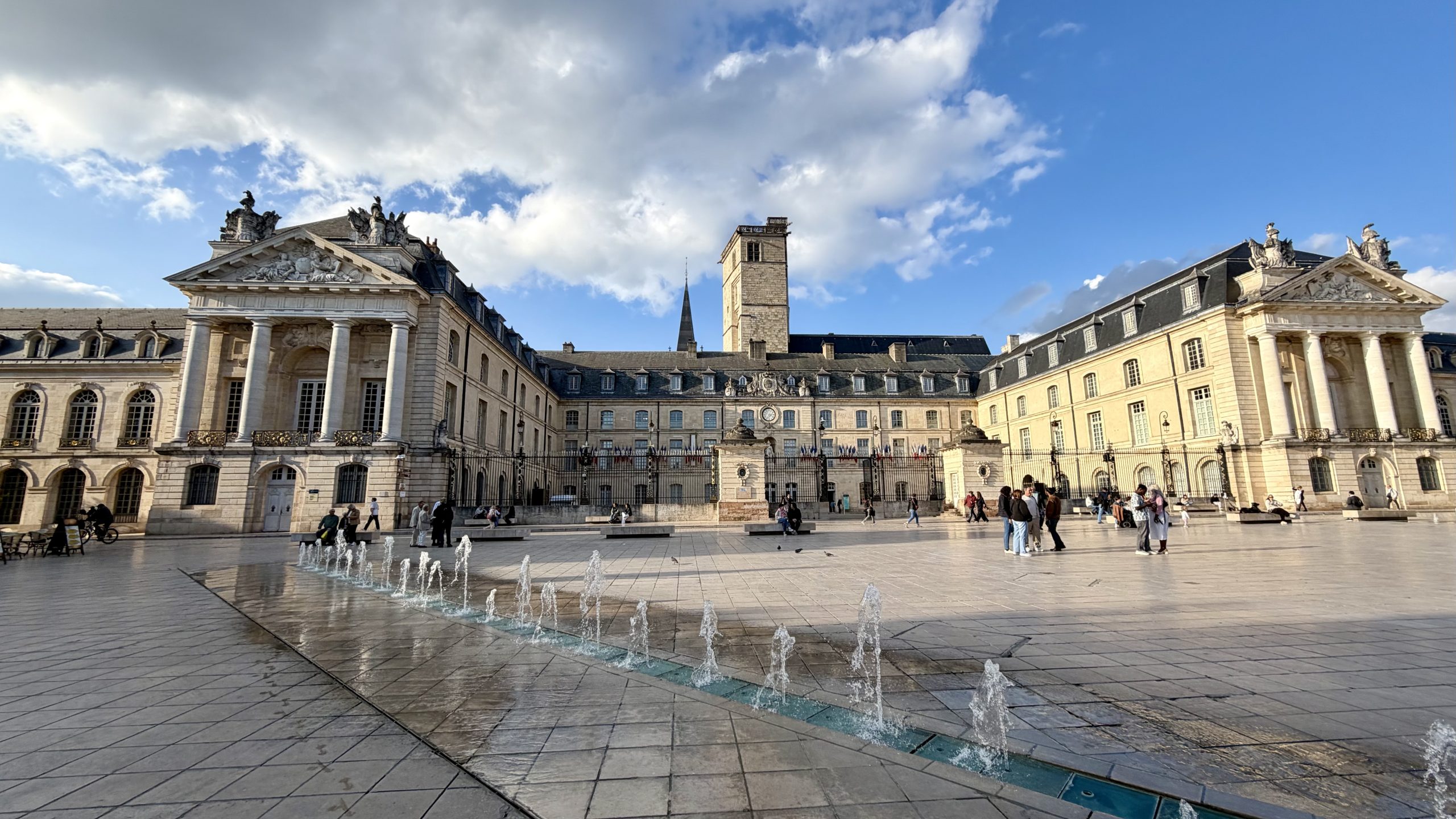
Why Dijon, France?

This is a question we’ve been asked many times, including this comment from one of the travelers on our Iceland trip last year (and repeat Six-Pack of Peaks challenger) Amy, who wrote:

 I’d love to hear more about why/how you chose France vs Spain, Portugal, or Italy and what was your process for figuring out which city to move to within France. Also, did you do all of your own research or did you use a service to help steer you along the way?

First a little background. We have lived overseas once before, when Joan worked for an international school in Seoul, South Korea. It was a great experience and a very easy transition. At the school, we had a built-in community of English-speaking expats from around the world, and Seoul is a modern city with all of the modern conveniences you would expect — a great public transit system, every kind of cuisine you can imagine. It was different, yet familiar.

We’ve always talked about living in Europe at some point, but due to work obligations, it always felt like more of a “someday” dream — more concept than concrete.

That perspective shifted as I looked at retirement and began to think that maybe the time was right.

Initially, we didn’t settle on Dijon or even France. We just loved the idea of living in Europe and the ease of traveling and experiencing so many different countries so easily. I saw a news story of a village on Sardinia offering the infamous 1 euro house deal and imagined what it would be like to refurbish an ancient home in a small, remote village. That seemed a bit too remote and far removed for our tastes, but it did get me thinking about how close other places in Europe are, and how easy it would be to travel to the UK, Spain, Italy, the Netherlands and more.

At this point the algorithm kicked in and started suggesting content. We learned about an expat couple that moved from Missouri to Albania, and followed that rabbit hole. Joan had a friend who moved to Portugal, and so we did some research on that (many of the doors are closing there).

Then on October 26, 2025 we watched this video from Amelia and JP Abroad on their 10 favorite retirement spots. They listed cities across the world, but Dijon, France piqued our interest. It seemed to have the right mixture of history, vibrant culture and modernity

From that, the algorithm suggested Suzi from Fired Up in France. Suzi is an American expat who has been living in Dijon for 17 years, and has a great channel with a lot of content for people curious about moving to France in general, and Dijon in particular.

This kicked off more research, learning about moving to France and getting to know the city of Dijon.

There are many wonderful things about France, and one of the financial elements that tips the scale is their favorable tax treaty with the U.S.. We still file and pay income taxes in the U.S., but don’t get double taxed in France — not true for all countries.

As for where in France, there are many wonderful cities, towns and villages to choose from. For us, we liked the climate of Dijon — very similar to what we experienced in Bend, Oregon, but with slightly warmer winters and slightly cooler summers. We didn’t want hot and sunny, but we also wanted more than a village — something where we could immerse ourselves in French culture, history, food and wine but also enjoy great public transportation, excellent walkability (Dijon has entire sections of centre-ville that are pedestrian-only), and good cost of living (about 30% lower than Bend, Oregon).

Dijon is located roughly 1 hour 40 minutes from Paris by high-speed rail, and we have excellent high-speed rail connections that can get us throughout Europe. Plus, most of the trains allow dogs, which is important for our two labradoodles.

Once we decided on the move, we enlisted help from two companies. Daniel Tostado Avocats helped us with our long-stay visitor visas. These allow us to establish residency in France, but there is a fair amount of paperwork to go through — tax records, bank statements, proof of income — and they were very helpful guiding us through the process. We had to travel to San Francisco to submit our paperwork, and we didn’t want to have to go through that process twice.

We started looking for long term rentals, initially using Seloger.com. Initially, we were getting virtually acquainted with the various neighborhoods and the rental market. About a month before we were scheduled to land in France, we worked with Ibanista to help us focus our search. They were extremely helpful in scheduling (and translating) walkthroughs, ultimately finding the apartment we ended up loving and walking us through the details of the lease agreement (which of course, is in French).

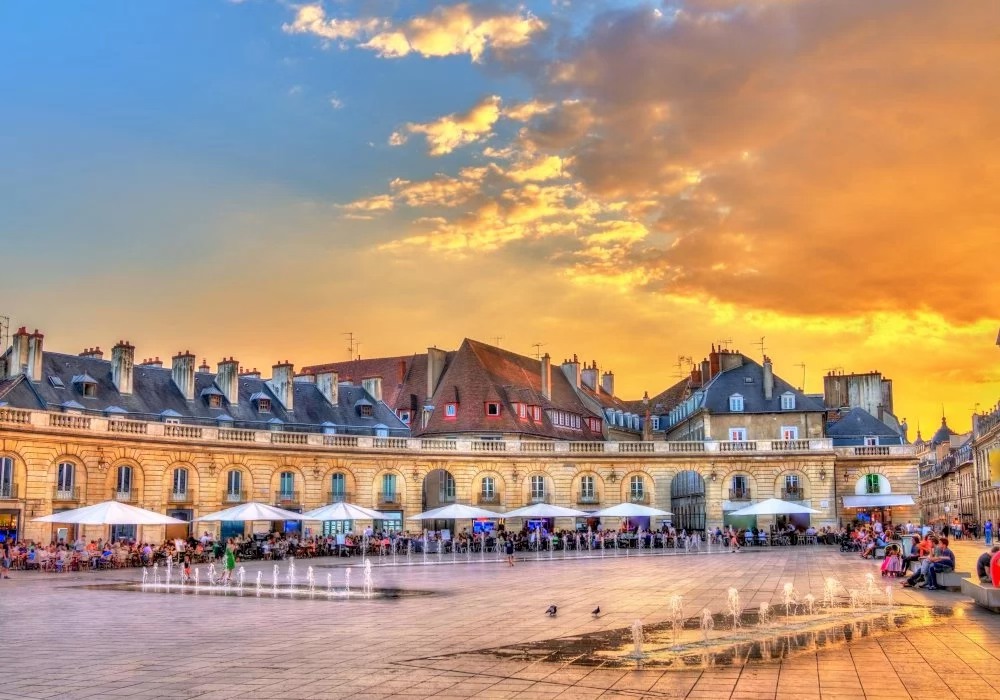
In six months we went from dream to reality. Now we are walking the dogs through centre-ville, stopping for a coffee and a croissant, and slowing down to savor the day.

We’re still setting up the apartment and getting settled in, but Dijon feels like home.

Posted on Leave a comment

Tectonic Shift Ahead

We’ve been sitting on this one for a while.

After a lot of conversations, long walks, and asking ourselves what we want the next chapter of our life to look like, we’ve decided it’s time for a change. This May, Joan and I are moving to Dijon, France.

Bend has been our home for the past nine years, though we’ve bounced around between LA and the Bay Area for work, it’s here where we’ve built community, friendships, and a life we’re deeply grateful for. Leaving Bend doesn’t mean we’re closing the book on this place or the people here. We’re just turning the page.

This move isn’t about running from anything. It’s about curiosity, a different pace of life, and choosing new adventures while we still can. Everything that matters most to us — connection, time outside, shared meals and good conversations — all come with us.

We are excited. And more than a little nervous. And very aware of how lucky we are to get to do this.

And yes, our door is always open to friends. Burgundy hikes, bike paths, wine, and long, leisurely French lunches are officially on the menu. ????

Posted on Leave a comment

Day 19 in Paris: Love, Locked

Love, Locked

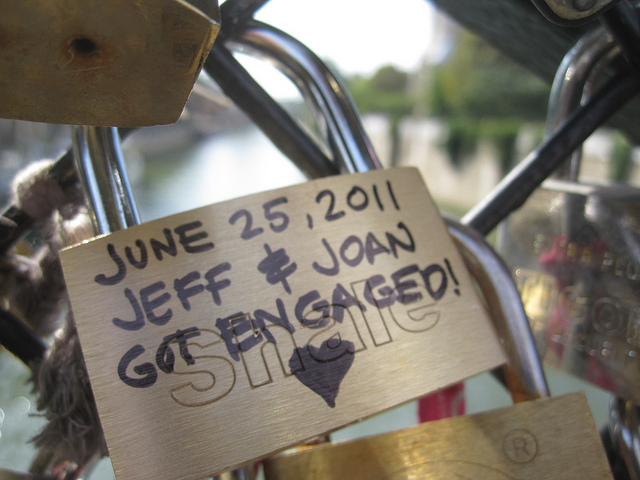
If you look closely, you’ll find our lock on this bridge near Notre Dame.

This is a wonderfully odd real-world meme. The story I heard from a guy in our cooking glass (who has lived here in Paris for the past nine years) was that the guy who started this was despondant over unrequited love. He “locked his love” to the bridge, the jumped off and drowned in the Seine.

Not sure if that’s true, but since then, lovers have taken the idea to an extreme. And area sales of padlocks and Sharpie pens has never been better.

Oh, if you look closely, you’ll see a padlock for Joan and I, too. And that alone was reason enough for me to chose this as my Day 189 photo for Project 365.

For more on our trip to Paris, check out Joan’s travel blog and our Memolane timeline.

Posted on Leave a comment

Day 18 in Paris: Refuge des Fondus

Joan at Refuge des Fondus

One of the meals we wanted to enjoy was fondue. A quick search on Yelp turned up what sounded like a fun place in Montmartre called Refuge des Fondus. It’s small with a fixed menu. You get an apertif, an entree, your choice of cheese or beef fondue, wine (served in baby bottles to avoid the per glass tax), and if you choose, desert afterwards.

There are a row of tables along each wall of the narrow restaurant, with no room to scoot to the bench. So the waiter helps the ladies step on a chair and hop OVER the table.

When you’re finished, you can sign your name or leave a message on the wall, the ceiling, or anywhere you can find a scrap of available space. That’s what you see behind the beautiful Joan in this photo, #188 from Project 365.

C’est magnifique! And a lot of fun, too.

For more about our trip to Paris, be sure to check out Joan’s travel blog and our Memolane story.

Posted on Leave a comment

Day 17 in Paris: Old Bones in the Catacombs

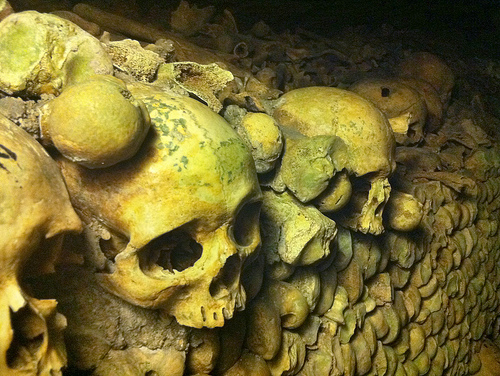
On our 17th day in Paris, we visited the Catacombs. There’s a formal name for this which eludes me, because this is actually a cemetery of sorts.

It was created in the late 1700’s when overcrowding at the graveyards which traditionally surrounded each church became a serious health problem. The catacombs were a network of underground tunnels originally created as builders mined for stone for more buildings.

Each of the graveyards was transferred to a specific section of the catacombs and marked, so if you know where your loved ones were originally buried, you’d be able to find their new subterranean home, too. There are 6-7 millions Parisians in the catacombs.

It’s rather creepy. I’m glad we went, for the historical value, but for the most part, this photo shows you pretty much all you’ll see.

Oh, and you’re looking at my photo for Day 187 of Project 365.

For more on our trip to Paris, read Joan’s travel blog and check out our Memolane story.