
Posted on 2 Comments

Knowledge Management, Highways, Byways and Cars

Chris Collison (which I keep wanting to read as collision for reasons that will soon become apparent) is a KM consultant and author who will be speaking to 600 law librarians on the subject of mapping the KM landscape. It’s a fertile and provocative analogy, and was the focus of today’s KMers.org tweet chat.

Collison suggests that the highway represents the mainstream tools, techniques and functionality that are widely regarded as intrinsic to any decent KM environment. But you also find winding country roads that take you off the beaten track but are worth the detour. And occasionally you are delighted to discover a spectacular view open up while exploring some uncharted corner of the world.

There are also parallel routes — canals and railways which might compete with or provide an option to the highway. And finally there are the swamps, quicksand and dead-ends that we wish we had never turned into.

I was dumbstruck when Collison asked the group what the highways consisted of, and very quickly the answers that came back were technology solutions. KM is much bigger and broader than any wiki, blog or discussion forum. It’s bigger than Sharepoint or Yammer. It involves first and foremost the people. Engaging people, giving them a reason to share their knowledge and expertise. Making sense of KM so that they can answer the WIIFM* question.

I wrote about this a couple weeks ago after I read Nick Milton’s post on Knowledge Management before IT. KM isn’t really anything new. We’ve been doing it for centuries. We may have called is something different, but the key need was the same; to pass knowledge from one person to another.

Simon Burnett summed up the risk with “shiny objects” (i.e. cool tools) nicely:

[blackbirdpie url=”http://twitter.com/#!/Simon_Burnett/status/42641774631596032″]

So many IT-led KM initiatives have failed, mainly because of their focus on the tools. Which led me to think. The tools we use to manage knowledge are analogous to the car that we use to drive down that KM highway. There are all kinds of cars. Expensive cars. Fast cars. Sexy cars. Safe cars. SUVs. And even plain cars. Any of them (assuming proper working order) can get you from Point A to Point B. Possessing the car, even a top of the line model, will not help you reach your destination if you don’t know where you’re going or how you’re going to get there.

The kind of car you drive matters much less than having well-defined goals and a plan to reach them. Without a plan, that shiny car will just help you reach your dead-end faster.

Join the Discussion

Are you involved in knowledge management? Join the discussion at KMers.org each Tuesday on Twitter. You can view the upcoming schedule  and learn how to participate at KMers.org. Thanks to Chris Collison for moderating this week’s discussion (and good luck on your keynote!), and thanks to Jeffrey Brandt, Randy Ramsey, Leonard Kish, Mary Abraham, Tom Menke, Matthew Loxton, Roxanna Samii and many others for the stimulating discussion on the KM landscape.

And special thanks to Stan Garfield for his Trackback Tuesday tweet:

[blackbirdpie url=”http://twitter.com/#!/stangarfield/status/42627865057046529″]


Photo credit: Benny Lin

*What’s In It For Me?
Posted on 7 Comments

Successful KM Storytelling

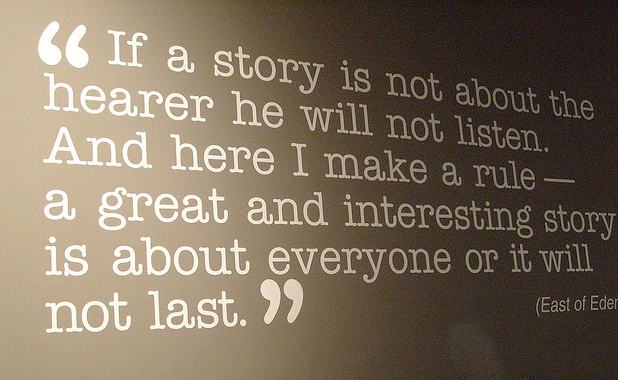
If a story is not about the hearer he will not listen... - Steinbeck

Before we developed written languages, storytelling allowed us to pass down our history and knowledge from one generation to the next. Even today, storytelling remains a powerful medium. A well-told story with a meaningful message is easier to remember, internalize and share.

Earlier today I chatted with fellow knowledge management (KM) colleagues at KMers.org on the subject of corporate storytelling and knowledge management, and I promised to share my storytelling story.

At Fluor, storytelling almost always takes a written form. Naturally, people share their stories in person or in teleconferences, but our emphasis is on written stories. This definition of “storytelling” is different from many other organizations.

Our stories are real-world examples that illustrate the value of knowledge management. I recognize that there are stories that do not involve either success nor any form of knowledge sharing. While they can be valuable in their own right, they fall out of my organization’s scope.

These KM success stories are collected both informally and formally. Informally, we simply ask people to share examples of how knowledge sharing (a more accessible term than KM) and collaboration has benefited them, their project or the client. This past year we asked this question in on of our KM discussion forums and had over 30 responses — some good, some great and some everyday examples of KM at work. The best of these were identified and more formally captured.

Our formal success story process encourages people to share stories year-round. Each year during the month of Knowvember we review the stories shared over the past 12 months, selecting a list of finalists. These are presented to a panel of C-level executives that select the winning stories. There is no fixed number of finalists or winners, but in 2010 we collected roughly 300 stories, culled this down to 20 finalists from which the executives selected six winners. If you’re success story is selected as a winner, you get to select a local charitable organization to which a $500 donation is made in your name.

Sharing Success

We use a specific form designed to guide you through the success story process. It asks for a description of the story and how it brought value, and prompts for supporting metrics, quotes and details.

Our guidelines are pretty simple:

  1. Share your success story in the most appropriate knowledge community (our virtual communities of practice). If you’re not sure where it best fits, we help guide you.
  2. Read the instructions on the success story form, filling it out completely.
  3. Define what specific elements make the story a success. What internal or client value was generated?
  4. Add images and quotes to give the story added credibility.

We supplement these basic guidelines with a few good examples from previous years.

Some of these stories are shared with a well-written narrative voice. Others have obvious value, but need to be rewritten in a way that really tells the story with impact.

Along the way, these stories are shared though our KM system, with new messages displayed a couple times each week providing a regular and not-so-subtle reminder of how knowledge sharing can generate value.

During the final judging for the annual contest, the exposure these stories and the people involved get at a very high level of the organization serves two purposes: it provides recognition to folks who are often from far flung offices, and it reminds our executives of some very concrete ways KM strengthens and improves our company. And we’ve found that these stories provide the most tangible measure of the value of knowledge management — much more than the number of clicks and downloads.

What’s Next for Storytelling?

We conducted a very low-budget experiment last year, and was a big success. We asked our local KM champions to use their smartphones and video-capable digital cameras to record a few employees — very informally and without rehearsal — answering just a three questions:

  1. What was the last thing you did in our KM system?
  2. What was their favorite knowledge community (CoP) and why? And
  3. Who encourages you to share and leverage knowledge?

These low-budget, quick-and-dirty video recordings were reviewed and we created a series of short, 2-3 minute compilation videos. The results are compelling, and we will likely do this again, perhaps with different questions. While they won’t replace the more formal success story process, they do provide a compelling story for other employees.

Of course, there are many ways to tell a story. This is just ours, and as with all KM efforts, we are constantly evolving and adapting to improve the process.

What’s your storytelling story?

Thanks to Lilly Evans for moderating today’s KMers.org tweet chat! You can read the complete transcript here.