Posted on 8 Comments

Putting BigBlueBall into the WayBackMachine

WayBackMachine

In my last post, I talked a bit about the history of BigBlueBall.com. For shits and grins, I popped into the WayBackMachine to travel back through time and see what the site looked like “back when.”

Some of the captures on the WayBackMachine are missing a few bits and pieces — some CSS here and and image there — but you’ll get the gist.

1999 – A Web Portfolio

In 1999, this site served as an online portfolio of web projects that Jim Styles and I had worked on. It was hosted on Microsoft IIS with a SQL Server backend to give us flexibility to demonstrate our ASP coding skills.

2001 – Re-launched with a Focus on Instant Messaging

In 2001 the dot-com bubble had burst. The startup I had worked for shuttered. And I repurposed BigBlueBall as an online community supporting instant messaging. We were still running on ASP and using Snitz Forum software to drive the community component.

The site went through a number of redesigns as we tried to get it right. Blue became the prominent color.

2004 An Evolving Design

The interface evolved to a fluid design that could expand to fill the resolution of your screen.

Headlines started to look like headlines. And we migrated from a Microsoft platform to open source PHP and vBulletin forums (which still look frozen in time to this day).

2010 – Migrating to WordPress and bbPress

Fed up with vBulletin being hacked over and over, we migrated to WordPress for the CMS and bbPress for the forums. At this point, the site was pretty quiet, and the forums where a ghost town. Facebook took over the world, or a big chunk of it.

Next up… looking back at the key contributors

Were you a participant or moderator in the BigBlueBall forums back in the day?

Here are a few of the names that stand out (in no particular order):

I want to hear from you. Leave a comment with your BBB username and I will be in touch.

Posted on 2 Comments

Project: Revival

Decades ago (back in the late 90’s) I was looking for a domain name to use for a portfolio website. Of course, even in the late 90s, many of the “good” names were already registered. I ended up going with BigBlueBall.com, as it reminded me of the descriptions of planet Earth as seen from outer space.

In 2001, I repurposed the domain as a public news and discussion forum around the topic of instant messaging. At one point, we had over 40,000 form members discussing AIM, ICQ, Trillian, MSN Messenger and so many more. The website was getting over 500,000 pageviews a month in 2006.

As Facebook and smartphones took off, interest in instant messaging waned. One by one, most of the old instant messaging applications eventually shut down.

And my personal interests shifted more toward being unplugged and outdoors.

In 2010 two things happened that essentially “killed” BigBlueBall.

First, the site was hacked, not just once, but multiple times throughout the year. Specifically, the discussion forums were hacked to redirect to other websites. The first hack was on February 18, 2010. I would undo the hack, repair the website, and it would get hacked again and again. This went on for about a year until finally in early 2011, we migrated to a new system that ended the attacks.

Second, I launched SoCalHiker.net. I was training to thru-hike the 211-mile John Muir Trail (JMT), and redirected my extracurricular energies into sharing my hike guides, JMT planning resources and gear reviews. It fit better with my personal focus and was a whole lot more fun than battling hackers.

BigBlueBall.com pageview analytics
Fairly steady traffic, a dreadful 2010, and slight recovery and a slow crawl to obscurity

The changes I made to BigBlueBall in 2011 resolved the problems we dealt with throughout 2010, but the web traffic never recovered. Interest in messaging had shifted. My interests had shifted. And the organic traffic we had from Google never quite recovered.

Fast forward to 2020

I occasionally get unsolicited offers to buy BigBlueball via email. Most of the time I ignore them, but when I had one pop-up in my inbox last month, it made me think. Maybe I could reinvigorate the website and breath a bit of life back into it.

And so I’m embarking on yet another side project: revitalizing BigBlueBall.com. I’m going to invest four hours per week to see what I can do to turn those pageview statistics around and breathe new life into an old website.

Let’s call it a BigBlueBall Revival.

Posted on Leave a comment

30 Days of Creativity: Done

Back in May, a friend posted a note about the 30 Days of Creativity challenge. It’s an annual event designed to encourage and inspire personal creativity every day for each of the thirty days of June–with the added benefit of actually building a habit of creating.

I love a challenge. So I signed up and committed to creating something every day.

Most of my creations have a photographic root. I enjoy photography, and with my iPhone in my pocket, I always have a camera with me.  For this challenge, I  flexed my creative muscles, creating one haiku, two infographics, two sketches, one hand-lettered note, two videos, and of course, many, many photos.

One outgrowth of this is that I started up a Muir Monday meme that fits nicely with my hiking web site. Each Monday, I’m taking a photo that I took and combining it with words of wisdom from John Muir.

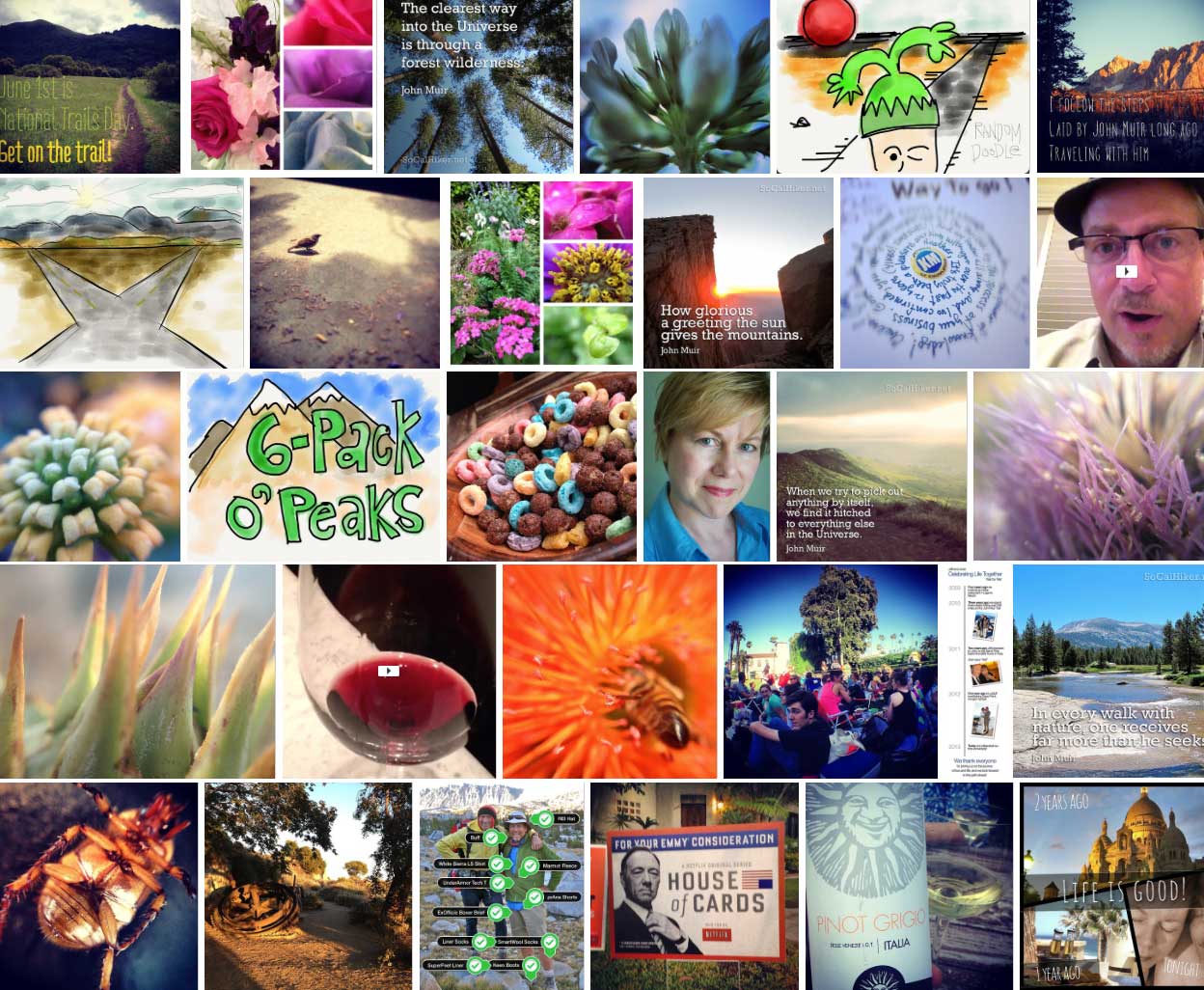
Here’s a collage of all thirty creations in chronological order, or you can view the entire set in all its interactive glory.

30 Days of Creativity - 2013


I encourage you to take on your own challenge. Flex your creative muscle. Go outside of your comfort zone. You might find it habit-forming.

Posted on 1 Comment

Project 365 – 2011, One Photo a Day

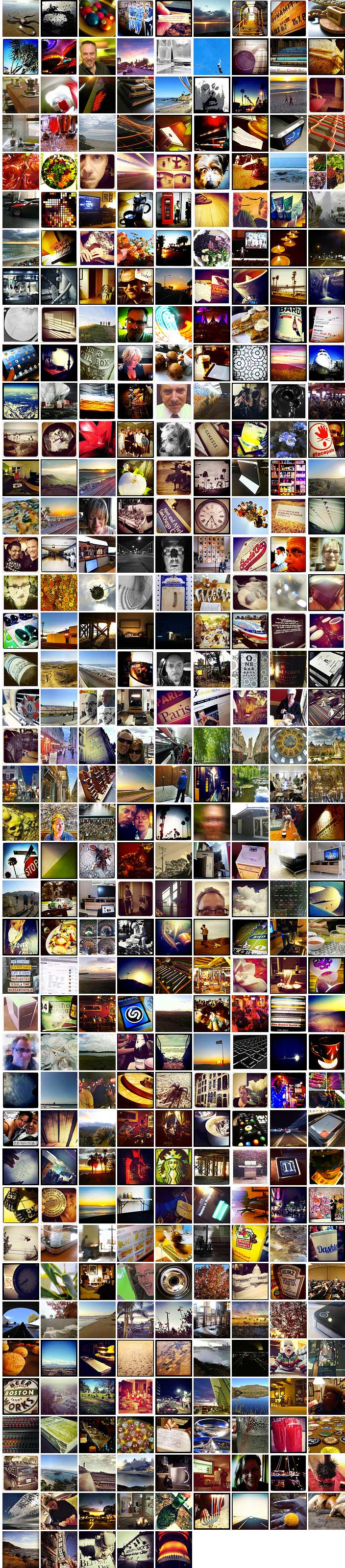
Last year I decided to undertake the popular Project 365 photo meme. The goal is to take and post at least one photo every day for 365 days. While you can start at any time, I began my project on January 1, 2011. Here is the result, one year later.

There are many ways to participate in Project 365. I chose Flickr, mainly because I’ve been using the site for years and it’s comfortable like an old pair of favorite shoes. They have a great community and lots of groups devoted to the Project 365 meme.

Most of my photos were taken with my iPhone, which I use more and more frequently. For some I used my Canon SD780 point-and-shoot. I didn’t generally get fancy or do a lot of planned shots. Most were what I would describe as “opportunistic,” and reflect what I did or where I was that day. It’s wonderful to scan the thumbnails and take a visual stroll through 2011.

One thing I learned — it was sometimes difficult to find something worthy of sharing. Some days I would be so busy, I’d nearly forget to shoot a photo until late in the evening. Which explains the many still images of “stuff” around my study.

When January 1st 2012 rolled around, I breathed a sigh of relief. Even though it took me a couple weeks to finish posting, tagging, titling and organizing the photos, I was free to not take a photo, if I so chose. Would I do it again? Sure! It was a lot of fun. But would I do it in consecutive years? Well, I’m not this year.


Posted on 1 Comment

WordPress Project: Book Launch Video Blog

This project was launched in December 2010 to coincide with the publication of Diana Mercer’s new book Making Divorce Work. Diana is an attorney who specializes in divorce mediation. Her mediation firm Peace Talks already has an established website and identity. For this companion site to the book, Diana wanted something that carried some of the same colors, but with a fun, hip and much more casual vibe.

I creating the site using WordPress, starting with an existing theme that she had seen used by someone else at WordCamp LA, and customizing the design with the colors and feel she was after.

Check out Diana’s Making Divorce Work blog, and I think you’ll agree: her personality and sense of humor shine through the site and her video posts. And Diana has done an amazing job of consistently posting content.


Posted on 12 Comments

What is the WordPress KM Project?

Knowledge Management is a term laden with baggage. For some people, KM synonymous with expensive IT systems and tools. For others it conjures memories of failed initiatives from a time past. But for most people, KM is a concept that they really don’t get.

Not that they need to “get it.” The term itself was invented by academians and consultants conspiring to elevate their science. But when the rubber meets the road, KM is simply about sharing and leveraging knowledge intelligently. The typical knowledge worker isn’t usually familiar with the term knowledge management or even knowledge worker. They just know that they need to tap into knowledge and expertise to help them do their job.

And so, we KM professionals are tasked with providing a systematic approach to KM that doesn’t burden knowledge workers with learning a whole new language. Taxonomy, vocabulary, subject matter experts, communities of practice — all are misguided labels that serve the KM professionals (we know what we mean) but obfuscate the message to the engineer on a project.

We need to put the process into terms they already know and understand. In many ways, Enterprise 2.0 concepts come closer. Blogs, social networking, profiles and discussion forums are all part of our common experience of the web. And they all fit nicely into a community-centric approach to knowledge management.

I’ve said many times that KM is not about the tool. Successful KM is more about the processes and behaviors that drive collaboration, knowledge sharing and reuse. Show people how they benefit when they share their knowledge and it doesn’t matter what the tool is. As long as that tool doesn’t impede your ability to connect with knowledge and the people who have or need expertise, which tool is almost irrelevant. Not exactly the message that the big software vendors want you to hear, but it’s true.


Which got me thinking: if it’s not about the tool, why not choose some tools that are readily and freely available? Could this not make KM accessible to many more companies, and perhaps spawn a new era of extra-enterprise collaboration?

Thus was born The WordPress KM Project. The goal is to create a community-centric knowledge management platform that leverages freely available and easily deployed technology — WordPress.

WordPress is primarily considered blogging software, but it can be much more. A single WordPress installation can now support multiple sites or communities. Plugins such as the BuddyPress suite add discussion forums and extensible user profiles. And the core WordPress system is already well-suited for content creation and management.

What are the key requirements for the WordPress KM Project?

  • User Management – Each user must have a profile that can contain contact information as well as skills and expertise. This is important in establishing context and building trust among people who may not know each other.
  • Communities – The core management of knowledge and expertise is delegated to domain experts. People interested in that domain are the primary participants of these communities.
  • Enterprise scope – Although knowledge and expertise is delegate to communities, the partipants have access to the full breadth and depth of knowledge across all communities.
  • Search – For most people, this will be the primary method of retrieving needed knowledge or expertise. For that reason, search — by default — must cross community boundaries.
  • Discussion – The primary medium for ad hoc collaboration and knowledge sharing. Each community will have discussion forums centered around the subjects relating to their domain expertise.
  • Blogs – This could also be considered news, but carries the advantage of allowing community participation through comments.
  • Knowledge – This is experience codified. Explicit knowledge stored in web page or other electronic form.

The goal of the WordPress KM Project is to build a working prototype environment, and then share the results with the world. To do this well, I need your help.

Do you have a passion for KM, WordPress, enterprise systems or just contributing to the greater good? I want to hear from you. Get involved, share your ideas, and join the team.

Let’s begin. Start by leaving a comment below.